


Al 3203 Powder
$0.00
Al 3203 Powder
| Product | Al 3203 Powder |
| CAS No. | 7429-90-5 |
| Appearance | Silvery-Gray Metallic Powder |
| Purity | ≥99%, ≥99.9%, ≥95%(Other purities are also available) |
| APS | 1-5 µM, 10-53 µM (Can be customized), Ask for other available size range. |
| Ingredient | Al2O3 |
| Density | 2.7g/cm3 |
| Molecular Weight | 27g/mol |
| Product Codes | NCZ-DCY-186/25 |
Al 3203 Description:
Al 3203 Powder is one of the numerous advanced ceramic materials manufactured by Nanochemazone. Nanochemazone produces too many standard grades when applicable, including Mil Spec (military grade); ACS, Reagent and Technical Grade; Food, Agricultural and Pharmaceutical Grade; Optical Grade, USP and EP/BP (European Pharmacopoeia/British Pharmacopoeia) and follows applicable ASTM testing standards. Typical and custom packaging is available. Additional technical, research and safety (MSDS) information are available. Please request a quote above for more information on lead time and pricing
Al 3203 Powder Related Information :
Storage Conditions:
Airtight sealed, avoid light and keep dry at room temperature.
Please contact us for customization and price inquiry
Email: contact@nanochemazone.com
Note: We supply different size ranges of Nano and micron as per the client’s requirements and also accept customization in various parameters.
Al 3203 powder
Al2O3 powder is an aluminum alloy composed of aluminum, copper, and manganese. It is renowned for its excellent strength and high fatigue resistance, making it an ideal choice for demanding environments and structural components. The precise composition and manufacturing process of Al 3203 powder ensure consistent quality and performance, making it a reliable material for numerous applications.
Overview of Al2O3 Powder
Al2O3 or aluminum oxide is a ceramic material known for its high hardness, excellent dielectric properties, refractoriness, abrasion and corrosion resistance. Alumina powder is the powder form of aluminum oxide used in a variety of applications.
Key properties of Al2O3 powder include:
High hardness and wear resistance
High melting point of over 2000°C
Low electrical and thermal conductivity
Excellent thermal shock resistance
Resistant to strong acids and alkalis
Low density around 3.95 g/cm3
Chemically inert material
White color powder available in various particle sizes
Chemical Composition of Al2O3 Powder
| Compound | Formula | Weight % |
| Aluminum oxide | Al2O3 | 99.5% min |
| Silicon dioxide | SiO2 | 0.05% max |
| Iron oxide | Fe2O3 | 0.08% max |
| Titanium dioxide | TiO2 | 0.03% max |
| Sodium oxide | Na2O | 0.05% max |
| Magnesium oxide | MgO | 0.03% max |
High purity Al2O3 powder contains over 99.5% aluminum oxide as the principal component. Maximum impurity limits are specified for silica, iron oxide, titania, and other oxides.
| Property | Value |
| Melting point | 2050°C |
| Density | 3.95 g/cm3 |
| Hardness | 9 Mohs |
| Flexural strength | 330 MPa |
| Compressive strength | 2600 MPa |
| Porosity | <1% |
| Thermal conductivity | 30 W/m.K |
| Electrical resistivity | >1014 ohm.cm |
| Dielectric strength | 15-35 kV/mm |
| Water absorption | 0% |
Production Methods for Al2O3 Powder
The common production methods for Al2O3 powder include:
Bayer Process – Alumina trihydrate is extracted from bauxite ore and thermally converted to alumina powder. This process yields high purity powder.
Hall–Héroult Process – Alumina is dissolved in molten cryolite and electrolyzed to produce aluminum. Alumina powder is recovered as a by-product.
Calcination – Dehydration and calcination of various aluminum hydroxides to form alumina powder.
Sol-gel – Alumina gel is formed from aluminum alkoxides or nitrates and then dried and calcined to make nanoscale alumina powder.
Flame Pyrolysis – Vapor phase combustion of aluminum chloride produces ultrafine alumina powder.
The Bayer process is the most common industrial method while the others yield specialty grade alumina.
Applications of Al2O3 Powder
Abrasives – For grinding, sanding, polishing, blasting media due to its hardness.
Refractories – High temperature furnace linings, ceramics, firebricks for metallurgy, glass, cement industries.
Ceramics – Electrical, structural, biomedical applications using alumina ceramics.
Catalysts – Gamma alumina used as catalyst support and directly as catalyst.
Coatings – Thermal spray coatings for wear and corrosion protection.
Polishing – CMP slurries for polishing silicon wafers, optic components, metals.
Fillers – Added to plastics, rubber, paper to improve mechanical properties.
Cosmetics – For manufacturing makeup, personal care products.
Specifications of Al2O3 Powder
Al2O3 powder is available under various purity levels, particle size distribution, and grades:
Purity – From industrial (90%) to high purity (99.99%) grades based on impurity levels.
Particle Size – Ranging from nanoscale (10-50 nm) to coarse grade (over 100 microns).
Phases – Alpha, gamma, theta, delta phases have different properties.
Grades – Conforming to standards for abrasives, technical ceramics, bioceramics, etc.
Surface Area – For nanosized powder, surface area is 1-100 m2/g.
Morphology – Regular and spherical shaped particles preferred.
Applications – Powder customized for composites, 3D printing, other uses.
Health and Safety When Handling Al2O3 Powder
Al2O3 powder does not pose severe health and safety risks but standard precautions should be taken:
Use dust masks or respirators to avoid inhaling fine particles during handling.
Wear protective goggles and gloves while handling powder.
Prevent skin contact to avoid drying and irritation.
Avoid generating and breathing airborne dust. Ensure adequate ventilation.
Handle and store powder carefully avoiding dispersion in air.
Properly dispose of waste powder based on environmental regulations.
Refer to Material Safety Data Sheet (MSDS) provided by the supplier for complete health hazard data.
Inspection and Testing of Al2O3 Powder
Key tests carried out for quality control of Al2O3 powder are:
Chemical analysis using X-ray Fluorescence (XRF) or Inductively Coupled Plasma (ICP) techniques to ensure composition meets specifications.
Particle size analysis through laser diffraction or dynamic light scattering method.
Scanning Electron Microscopy (SEM) to examine particle morphology.
Specific surface area measurement using gas absorption technique.
X-ray diffraction (XRD) analysis to determine phases present.
Impurity analysis for trace metallic elements using ICP mass spectrometry.
Loss of mass on ignition when heated to 1000°C.
Density measurement through pycnometry method.
Thorough inspection and testing ensures the powder meets the quality and performance requirements of specific applications.
Comparison Between α-Al2O3 and γ-Al2O3 Powder
α-Al2O3 and γ-Al2O3 are two common phases of alumina powder compared here:
| Parameter | α-Al2O3 | γ-Al2O3 |
| Crystal structure | Hexagonal | Cubic |
| Density | 3.95 g/cm3 | 3.65 g/cm3 |
| Hardness | 9 Mohs | 8 Mohs |
| Melting point | 2050°C | ~1100°C |
| Thermal conductivity | 30 W/m.K | 5-10 W/m.K |
| Surface area | <10 m2/g | 100-300 m2/g |
| Applications | Abrasives, ceramics | Catalysts, adsorbents |
| Price | Lower | Higher |
α-Al2O3 has higher hardness, density, thermal conductivity and refractoriness whereas γ-Al2O3 has higher surface area and extensively used in catalysts. α-form has wider applications and lower price.
FAQs
Q: What is Al2O3 powder used for?
A: Al2O3 powder is used to manufacture abrasives, refractories, structural ceramics, ceramic coatings, polishing compounds, plastic & rubber fillers, and other applications due to its high hardness, strength, and corrosion resistance.
Q: What is the difference between white, pink, and brown alumina powder?
A: White alumina is high purity Al2O3. Pink and brown alumina contain small amounts of chromium and iron oxides respectively that impart color. White alumina is used when color contamination must be avoided.
Q: Is Al2O3 powder hazardous?
A: Al2O3 powder is generally not classified as a hazardous material but like all fine powders can cause irritation and breathing issues during handling. Use of proper PPE is recommended.
Q: What is the difference between fused and sintered alumina powder?
A: Fused alumina is produced by melting pure alumina whereas sintered type is made by compacting and firing alumina powder. Fused alumina has higher purity and density compared to sintered.
Q: Where can I buy Al2O3 powder for making ceramic components?
A: High purity fine alumina powder for ceramic applications can be purchased from leading suppliers . Ensure the powder meets specifications for your application.
Description
Description
Note: For pricing & ordering information, please get in touch with us at sales@nanochemazone.com
Please contact us for quotes on Larger Quantities and customization. E-mail: contact@nanochemazone.com
Customization:
If you are planning to order large quantities for your industrial and academic needs, please note that customization of parameters (such as size, length, purity, functionalities, etc.) is available upon request.
NOTE:
Images, pictures, colors, particle sizes, purity, packing, descriptions, and specifications for the real and actual goods may differ. These are only used on the website for the purposes of reference, advertising, and portrayal. Please contact us via email at sales@nanochemazone.com or by phone at (+1 780 612 4177) if you have any questions.
Reviews (0)
Only logged in customers who have purchased this product may leave a review.
Shipping & Delivery
Related products
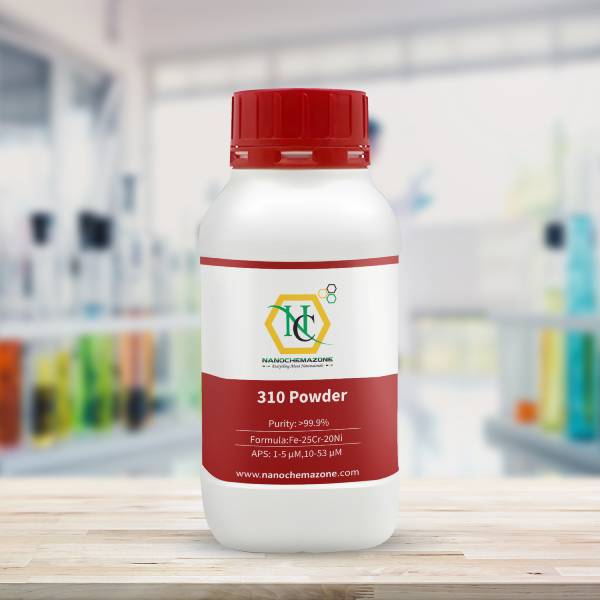
310 Powder
310 Powder
| Product | 310 Powder |
| CAS No. | 12060-00-3 |
| Appearance | Silvery Powder |
| Purity | ≥99%, ≥99.9%, ≥95%(Other purities are also available) |
| APS | 1-5 µM, 10-53 µM (Can be customized), Ask for other available size range. |
| Ingredient | Fe-25Cr-20Ni |
| Density | 7.9g/cm3 |
| Molecular Weight | 150-160 g/mol |
| Product Codes | NCZ-DCY-170/25 |
310 Description:
310 Powder is one of the numerous advanced ceramic materials manufactured by Nanochemazone. Nanochemazone produces too many standard grades when applicable, including Mil Spec (military grade); ACS, Reagent and Technical Grade; Food, Agricultural and Pharmaceutical Grade; Optical Grade, USP and EP/BP (European Pharmacopoeia/British Pharmacopoeia) and follows applicable ASTM testing standards. Typical and custom packaging is available. Additional technical, research and safety (MSDS) information are available. Please request a quote above for more information on lead time and pricing310 Powder Related Information :
Storage Conditions: Airtight sealed, avoid light and keep dry at room temperature. Please contact us for customization and price inquiry Email: contact@nanochemazone.com Note: We supply different size ranges of Nano and micron as per the client’s requirements and also accept customization in various parameters. 310 Powder 310 powder is an austenitic stainless steel powder containing high levels of chromium, nickel and nitrogen for enhanced mechanical properties and corrosion resistance. It offers an excellent combination of strength, hardness, toughness and wear resistance. Overview of 310 Powder 310 powder is an austenitic stainless steel powder containing high levels of chromium, nickel and nitrogen for enhanced mechanical properties and corrosion resistance. It offers an excellent combination of strength, hardness, toughness and wear resistance. 310 Powder Properties and Characteristics| Properties | Details |
| Composition | Fe-25Cr-20Ni-0.25N alloy |
| Density | 8.1 g/cc |
| Particle shape | Irregular, angular |
| Size range | 10-150 microns |
| Apparent density | Up to 50% of true density |
| Flowability | Moderate |
| Strength | Very high for a 300 series powder |
| Wear resistance | Excellent due to work hardening |
| Element | Weight % |
| Iron (Fe) | Balance |
| Chromium (Cr) | 24-26% |
| Nickel (Ni) | 19-22% |
| Nitrogen (N) | 0.2-0.4% |
| Carbon (C) | 0.25% max |
| Silicon (Si) | 1.5% max |
| Manganese (Mn) | 2% max |
| Sulfur (S) | 0.03% max |
| Phosphorus (P) | 0.045% max |
| Property | Values |
| Density | 8.1 g/cc |
| Melting point | 1370-1400°C |
| Electrical resistivity | 0.8 μΩ-m |
| Thermal conductivity | 12 W/mK |
| Thermal expansion | 11 x 10^-6 /K |
| Maximum service temperature | 1150°C |
| Property | Values |
| Tensile strength | 760-900 MPa |
| Yield strength | 450-550 MPa |
| Elongation | 35-40% |
| Hardness | 32-38 HRC |
| Impact strength | 50-100 J |
| Modulus of elasticity | 190-210 GPa |
| Industry | Example Uses | ||
| Petrochemical | Valves, pumps, shafts | ||
| Food processing | Extruder screws, blades | ||
| Automotive | Gears, shafts, fasteners | ||
| Manufacturing | Press tooling, bearing cages | ||
| Medical | Surgical instruments, implants | ||
| Standard | Description |
| ASTM A276 | Standard specification for stainless steel bars and shapes |
| ASTM A314 | Standard for stainless steel bent pipe and tubing |
| ASME SA-479 | Specification for stainless steel tubing |
| AMS 5517 | Annealed corrosion resistant steel bar, wire, forgings |
| AMS 5903 | Precipitation hardening stainless steel bar, wire, forgings |
| Particle Size | Characteristics |
| 10-45 microns | Ultrafine grade for high density and surface finish |
| 45-150 microns | Coarse grade provides good flowability |
| Apparent Density | Details |
| Up to 50% of true density | For irregular powder morphology |
| 4.5-5.5 g/cc typical | Improves with greater packing density |
| Method | Details |
| Gas atomization | High pressure inert gas breaks molten metal stream into fine droplets |
| Water atomization | High pressure water jet breaks metal into fine particles |
| Vacuum induction melting | High purity input materials melted under vacuum |
| Multiple remelting | Improves chemical homogenization |
| Sieving | Classifies powder into different particle size ranges |
| Recommendation | Reason |
| Use PPE and ventilation | Avoid exposure to fine metallic particles |
| Ensure proper grounding | Prevent static discharge while handling |
| Avoid ignition sources | Powder can combust in oxygen atmosphere |
| Use non-sparking tools | Prevent possibility of ignition |
| Follow safety protocols | Reduce risk of burns, inhalation, ingestion |
| Store in stable containers | Prevent contamination or oxidation |
| Parameter | 310 | 316L |
| Density | 8.1 g/cc | 8.0 g/cc |
| Strength | 760-900 MPa | 485-550 MPa |
| Hardness | 32-38 HRC | 79-95 HRB |
| Corrosion resistance | Very good | Excellent |
| Cost | Low | High |
| Uses | Wear parts, tools | Chemical plants, marine |
316L Stainless Steel Powder
316L Stainless Steel Powder
| Product | 316L Stainless Steel Powder |
| CAS No. | 69403-31-0 |
| Appearance | Silvery Powder |
| Purity | ≥99%, ≥99.9%, ≥95%(Other purities are also available) |
| APS | 1-5 µM, 10-53 µM (Can be customized), Ask for other available size range. |
| Ingredient | Fe-16-18Cr-10-14Ni-2-3-Mo |
| Density | 7g/.9cm3 |
| Molecular Weight | 150-160 g/mol |
| Product Codes | NCZ-DCY-171/25 |
316L Stainless Steel Description:
310L Stainless Steel Powder is one of the numerous advanced ceramic materials manufactured by Nanochemazone. Nanochemazone produces too many standard grades when applicable, including Mil Spec (military grade); ACS, Reagent and Technical Grade; Food, Agricultural and Pharmaceutical Grade; Optical Grade, USP and EP/BP (European Pharmacopoeia/British Pharmacopoeia) and follows applicable ASTM testing standards. Typical and custom packaging is available. Additional technical, research and safety (MSDS) information are available. Please request a quote above for more information on lead time and pricing316L Stainless Powder Related Information :
Storage Conditions: Airtight sealed, avoid light and keep dry at room temperature. Please contact us for customization and price inquiry Email: contact@nanochemazone.com Note: We supply different size ranges of Nano and micron as per the client’s requirements and also accept customization in various parameters. 316L Stainless Steel Powder 316L Stainless Steel Powder(ss316L) 316L is a stainless steel grade, which is classified according to the metallographic structure and belongs to austenitic stainless steel. Overview of 316L Stainless Steel Powder 316L is an austenitic stainless steel powder widely used in additive manufacturing to produce corrosion resistant parts with good mechanical properties and weldability. This article provides a detailed guide to 316L powder. Key aspects covered include composition, properties, AM process parameters, applications, specifications, suppliers, handling, inspection methods, comparisons to alternatives, pros and cons, and FAQs. Tables are used to present information in an easy-to-reference format. The composition of 316L stainless steel powder is:| Element | Weight % | Purpose |
| Iron | Balance | Principal matrix element |
| Chromium | 16-18 | Corrosion resistance |
| Nickel | 10-14 | Austenite stabilizer |
| Molybdenum | 2-3 | Corrosion resistance |
| Manganese | <2 | Deoxidizer |
| Silicon | <1 | Deoxidizer |
| Carbon | <0.03 | Avoid carbide precipitation |
| Property | Description |
| Corrosion resistance | Excellent resistance to pitting and crevice corrosion |
| Strength | Tensile strength up to 620 MPa |
| Weldability | Readily weldable and less prone to sensitization |
| Fabricability | Easily formed into complex shapes |
| Biocompatibility | Safe for contact with human body |
| Temperature resistance | Resistant up to 900°C in oxidizing environments |
| Industry | Applications |
| Aerospace | Structural brackets, panels, housings |
| Automotive | Turbine housings, impellers, valves |
| Chemical | Pumps, valves, reaction vessels |
| Oil and gas | Downhole tools, manifolds, flanges |
| Biomedical | Dental, orthopedic implants, surgical tools |
| Parameter | Specification |
| Particle size range | 15-45 μm typical |
| Particle shape | Spherical morphology |
| Apparent density | > 4 g/cc |
| Tap density | > 6 g/cc |
| Hall flow rate | > 23 sec for 50 g |
| Purity | >99.9% |
| Oxygen content | <1000 ppm |
| Method | Parameters Tested |
| Sieve analysis | Particle size distribution |
| SEM imaging | Particle morphology |
| EDX | Chemistry and composition |
| XRD | Phases present |
| Pycnometry | Density |
| Hall flow rate | Powder flowability |
| Alloy | Corrosion Resistance | Strength | Cost | Printability |
| 316L | Excellent | Medium | Medium | Excellent |
| 17-4PH | Good | High | Medium | Good |
| IN718 | Good | Very high | High | Fair |
| CoCr | Fair | Medium | Medium | Good |
| Pros | Cons |
| Excellent corrosion resistance and biocompatibility | Lower high temperature strength than alloys |
| Readily weldable and machinable | Susceptible to porosity during printing |
| Cost advantage over exotic alloys | Prone to thermal cracking |
| Can match wrought material properties | Required post-processing like HIP |
| Range of suppliers available | Lower hardness than precipitation hardening alloys |
Al 2024 Powder
Al 2024 Powder
| Product | Al 2024 Powder |
| CAS No. | 7429-90-5 |
| Appearance | Silvery or Metallic Powder |
| Purity | ≥99%, ≥99.9%, ≥95%(Other purities are also available) |
| APS | 1-5 µM, 10-53 µM (Can be customized), Ask for other available size range. |
| Ingredient | Al-4.4Cu-1.5Mg-0.6Mn |
| Density | 2.78g/cm3 |
| Molecular Weight | 110-120g/mol |
| Product Codes | NCZ-DCY-178/25 |
Al 2024 Description:
Al 2024 Powder is one of the numerous advanced ceramic materials manufactured by Nanochemazone. Nanochemazone produces too many standard grades when applicable, including Mil Spec (military grade); ACS, Reagent and Technical Grade; Food, Agricultural and Pharmaceutical Grade; Optical Grade, USP and EP/BP (European Pharmacopoeia/British Pharmacopoeia) and follows applicable ASTM testing standards. Typical and custom packaging is available. Additional technical, research and safety (MSDS) information are available. Please request a quote above for more information on lead time and pricingAl 2024 Powder Related Information :
Storage Conditions: Airtight sealed, avoid light and keep dry at room temperature. Please contact us for customization and price inquiry Email: contact@nanochemazone.com Note: We supply different size ranges of Nano and micron as per the client’s requirements and also accept customization in various parameters. Al 2024 powder Al 2024 powder is an aluminum alloy that primarily consists of aluminum, copper, and small amounts of magnesium and manganese. This alloy exhibits exceptional strength and excellent fatigue resistance, making it ideal for applications where lightweight materials with high mechanical properties are required. Al 2024 powder is commonly used in industries such as aerospace, automotive, and sporting goods. Overview of Al 2024 Powder Al 2024 is one of the most popular 2000 series wrought aluminum alloys known for its strength, fatigue resistance, and excellent machinability and corrosion resistance. The copper additions impart substantial strengthening through precipitation hardening while retaining formability and weldability. Key characteristics of Al 2024 powder include: High strength with moderate ductility and toughness Excellent fatigue and fracture resistance Very good machinability and polishability Good weldability and formability High thermal and electrical conductivity Available in range of powder sizes and shapes Al 2024 powder is suitable for aerospace components and other high-performance applications needing strength combined with fabrication capabilities. Chemical Composition of Al 2024 Powder| Element | Weight % |
| Aluminum (Al) | 90.7-94.7% |
| Copper (Cu) | 3.8-4.9% |
| Magnesium (Mg) | 1.2-1.8% |
| Manganese (Mn) | 0.3-0.9% |
| Iron (Fe) | 0-0.5% |
| Silicon (Si) | 0-0.5% |
| Zinc (Zn) | 0-0.25% |
| Chromium (Cr) | 0-0.1% |
| Titanium (Ti) | 0-0.15% |
| Property | Value |
| Density | 2.77 g/cm3 |
| Melting Point | 500-638°C |
| Thermal Conductivity | 121-190 W/mK |
| Electrical Conductivity | 26-35% IACS |
| Young’s Modulus | 73 GPa |
| Poisson’s Ratio | 0.33 |
| Tensile Strength | 400-500 MPa |
| Yield Strength | 290-385 MPa |
| Elongation | 8-20% |
| Hardness | 90-150 Vickers |
| Parameter | Al 2024 | Al 7075 |
| Alloy type | Heat treatable | Heat treatable |
| Cu content | 3.8-4.9% | 1.2-2% |
| Zn content | 0-0.25% | 5.1-6.1% |
| Strength | High | Very high |
| Fracture toughness | Higher | Moderate |
| Corrosion resistance | Good | Moderate |
| Weldability | Fair | Poor |
| Cost | Lower | Higher |
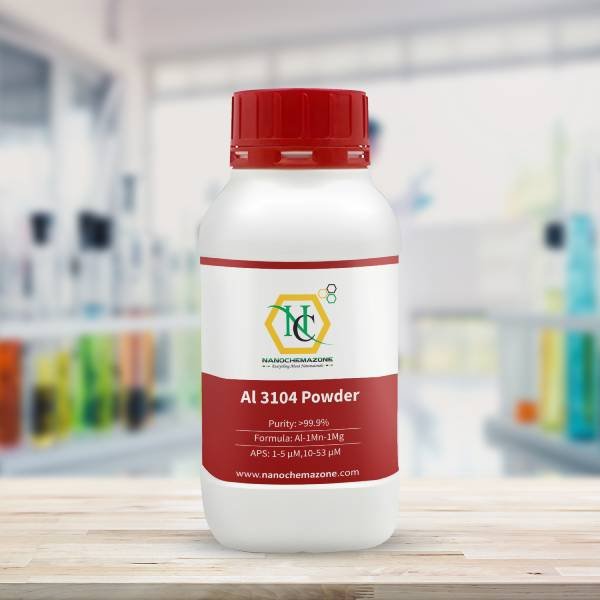
Al 3104 Powder
Al 3104 Powder
| Product | Al 3104 Powder |
| CAS No. | 7429-90-5 |
| Appearance | Silvery-Gray Metallic Powder |
| Purity | ≥99%, ≥99.9%, ≥95%(Other purities are also available) |
| APS | 1-5 µM, 10-53 µM (Can be customized), Ask for other available size range. |
| Ingredient | Al-1Mn-1Mg |
| Density | 2.72g/cm3 |
| Molecular Weight | 27g/mol |
| Product Codes | NCZ-DCY-183/25 |
Al 3104 Description:
Al 3104 Powder is one of the numerous advanced ceramic materials manufactured by Nanochemazone. Nanochemazone produces too many standard grades when applicable, including Mil Spec (military grade); ACS, Reagent and Technical Grade; Food, Agricultural and Pharmaceutical Grade; Optical Grade, USP and EP/BP (European Pharmacopoeia/British Pharmacopoeia) and follows applicable ASTM testing standards. Typical and custom packaging is available. Additional technical, research and safety (MSDS) information are available. Please request a quote above for more information on lead time and pricingAl 3104 Powder Related Information :
Storage Conditions: Airtight sealed, avoid light and keep dry at room temperature. Please contact us for customization and price inquiry Email: contact@nanochemazone.com Note: We supply different size ranges of Nano and micron as per the client’s requirements and also accept customization in various parameters. Al 3104 powder Al 3104 powder is an aluminum alloy composed primarily of aluminum (Al) with small additions of manganese (Mn) and magnesium (Mg). This powder form of the alloy offers distinct advantages in terms of its processability and versatility. It is commonly used in various industries due to its excellent combination of strength, corrosion resistance, and formability. Overview of Al 3104 Powder Al 3104 is a 3000 series wrought aluminum alloy known for its good corrosion resistance, excellent formability and weldability. Manganese additions provide strength through solid solution strengthening while maintaining ductility and toughness. Key characteristics of Al 3104 powder include: Moderate strength with excellent ductility Very good weldability and formability Excellent corrosion resistance High thermal and electrical conductivity Low density Available in various particle size distributions Al 3104 powder is suitable for chemical tanks, utensils, heat exchangers and applications needing moderate strength combined with good corrosion resistance. Chemical Composition of Al 3104 Powder| Element | Weight % |
| Aluminum (Al) | Balance |
| Manganese (Mn) | 1.0-1.5% |
| Silicon (Si) | 0.3% max |
| Iron (Fe) | 0.7% max |
| Copper (Cu) | 0.25% max |
| Magnesium (Mg) | 0.25% max |
| Zinc (Zn) | 0.20% max |
| Chromium (Cr) | 0.05-0.20% |
| Property | Value |
| Density | 2.73 g/cm3 |
| Melting Point | 634-643°C |
| Thermal Conductivity | 134 W/mK |
| Electrical Conductivity | 38-42% IACS |
| Young’s Modulus | 70 GPa |
| Poisson’s Ratio | 0.33 |
| Tensile Strength | 150-195 MPa |
| Yield Strength | 95-120 MPa |
| Elongation | 20-30% |
| Hardness | 45-65 Brinell |
| Parameter | Al 3104 | Al 3003 |
| Alloy type | Non-heat treatable | Non-heat treatable |
| Mn content | 1.0-1.5% | 1.0-1.5% |
| Strength | Slightly lower | Slightly higher |
| Corrosion resistance | Excellent | Excellent |
| Weldability | Excellent | Excellent |
| Cost | Lower | Higher |
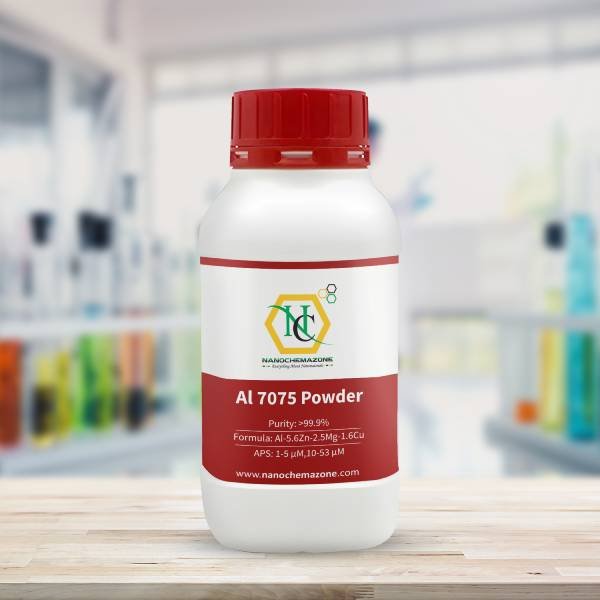
Al 7075 Powder
Al 7075 Powder
| Product | Al 7075 Powder |
| CAS No. | 7429-90-5 |
| Appearance | Gray Metallic Powder |
| Purity | ≥99%, ≥99.9%, ≥95%(Other purities are also available) |
| APS | 1-5 µM, 10-53 µM (Can be customized), Ask for other available size range. |
| Ingredient | Al-5.6Zn-2.5Mg-1.6Cu |
| Density | 2.81g/cm3 |
| Molecular Weight | 270g/mol |
| Product Codes | NCZ-DCY-179/25 |
Al 7075 Description:
Al 7075 Powder is one of the numerous advanced ceramic materials manufactured by Nanochemazone. Nanochemazone produces too many standard grades when applicable, including Mil Spec (military grade); ACS, Reagent and Technical Grade; Food, Agricultural and Pharmaceutical Grade; Optical Grade, USP and EP/BP (European Pharmacopoeia/British Pharmacopoeia) and follows applicable ASTM testing standards. Typical and custom packaging is available. Additional technical, research and safety (MSDS) information are available. Please request a quote above for more information on lead time and pricingAl 7075 Powder Related Information :
Storage Conditions: Airtight sealed, avoid light and keep dry at room temperature. Please contact us for customization and price inquiry Email: contact@nanochemazone.com Note: We supply different size ranges of Nano and micron as per the client’s requirements and also accept customization in various parameters. Al 7075 powder Al 7075 powder is a high-strength aluminum alloy composed primarily of aluminum, zinc, copper, and small amounts of magnesium and chromium. It is renowned for its impressive mechanical properties, making it an ideal choice for applications that require strength, durability, and lightweight characteristics. Al 7075 powder is typically produced through a process called atomization, where molten aluminum is sprayed and solidified into fine powder particles. Overview of Al 7075 Powder Al 7075 is one of the highest strength 7000 series aluminum alloys, offering strength superior to many steels. Zinc is the main alloying addition while magnesium imparts strength through precipitation hardening. Key properties of Al 7075 powder include: Exceptionally high tensile and yield strength High hardness and good fatigue strength Good toughness and moderate ductility Excellent finishing characteristics High corrosion resistance Available in range of powder sizes and shapes Al 7075 powder is ideal for high-performance aerospace and defense components needing the optimal combination of strength, hardness, fatigue resistance, and moderate weldability. Chemical Composition of Al 7075 Powder| Element | Weight % |
| Aluminum (Al) | 87.1-91.4% |
| Zinc (Zn) | 5.1-6.1% |
| Magnesium (Mg) | 2.1-2.9% |
| Copper (Cu) | 1.2-2.0% |
| Iron (Fe) | 0-0.5% |
| Silicon (Si) | 0-0.4% |
| Manganese (Mn) | 0-0.3% |
| Chromium (Cr) | 0.18-0.28% |
| Titanium (Ti) | 0-0.2% |
| Property | Value |
| Density | 2.81 g/cm3 |
| Melting Point | 477–635°C |
| Thermal Conductivity | 130–210 W/mK |
| Electrical Conductivity | 22-30% IACS |
| Young’s Modulus | 71–72 GPa |
| Poisson’s Ratio | 0.33 |
| Tensile Strength | 570–635 MPa |
| Yield Strength | 505–570 MPa |
| Elongation | 7–10% |
| Hardness | 150–190 Brinell |
| Parameter | Al 7075 | Al 6061 |
| Alloy type | Heat treatable | Heat treatable |
| Zn content | 5.1-6.1% | 0% |
| Mg content | 2.1-2.9% | 0.8-1.2% |
| Strength | Much higher | Moderate |
| Machinability | Poor | Excellent |
| Weldability | Poor | Very good |
| Corrosion resistance | Moderate | Excellent |
| Cost | Higher | Lower |

AlSi10Mg Powder
AlSi10Mg Powder
| Product | AlSi10Mg Powder |
| CAS No. | N/A |
| Appearance | Gray-Silver Metallic Powder |
| Purity | ≥99%, ≥99.9%, ≥95%(Other purities are also available) |
| APS | 1-5 µM, 10-53 µM (Can be customized), Ask for other available size range. |
| Ingredient | AlSi10Mg |
| Density | 1.2-1.5g/cm3 |
| Molecular Weight | N/A |
| Product Codes | NCZ-DCY-192/25 |
AlSi10Mg Description:
AlSi10Mg Powder is one of the numerous advanced ceramic materials manufactured by Nanochemazone. Nanochemazone produces too many standard grades when applicable, including Mil Spec (military grade); ACS, Reagent and Technical Grade; Food, Agricultural and Pharmaceutical Grade; Optical Grade, USP and EP/BP (European Pharmacopoeia/British Pharmacopoeia) and follows applicable ASTM testing standards. Typical and custom packaging is available. Additional technical, research and safety (MSDS) information are available. Please request a quote above for more information on lead time and pricingALSi10Mg Powder Related Information :
Storage Conditions: Airtight sealed, avoid light and keep dry at room temperature. Please contact us for customization and price inquiry Email: contact@nanochemazone.com Note: We supply different size ranges of Nano and micron as per the client’s requirements and also accept customization in various parameters. mize health and safety risks. AlSi10Mg powder AlSi10Mg powder is a composite material composed of aluminum (Al), silicon (Si), and magnesium (Mg). It is specifically designed for use in additive manufacturing processes, where it is used as a feedstock material for 3D printers.| Metal Powder | Size | Quantity | Price/kg | Size | Quantity | Price/kg |
| AlSi10Mg | 15-45μm | 1KG | 70 | 15-53μm | 1KG | 51 |
| 10KG | 42 | 10KG | 33 | |||
| 100KG | 34.6 | 100KG | 23.5 |
| Element | Weight % |
| Aluminum (Al) | Base/remainder |
| Silicon (Si) | 9-11% |
| Magnesium (Mg) | 0.2-0.45% |
| Other (Fe, Mn, etc.) | < 0.55% total |
| Element | Minimum wt% | Maximum wt% |
| Aluminum | Bal. | Bal. |
| Silicon | 9 | 11 |
| Magnesium | 0.2 | 0.45 |
| Other | – | 0.55 |
| Property | Typical Values |
| Density | 2.67 g/cc |
| Melting Point | ~615°C |
| Thermal Conductivity | 130 W/m-K |
| Electrical Resistivity | 4-8 x 10^-8 Ωm |
| Young’s Modulus | 70-80 GPa |
| Poisson’s Ratio | 0.33 |
| Yield Strength | 215-365 MPa |
| Tensile Strength | 330-430 MPa |
| Elongation | 8-10% |
| Hardness | 80-100 Brinell |
| Sector | Typical Applications |
| Aerospace | Turbine blades, structural brackets, rocket nozzles, satellites |
| Automotive | Powertrain, pistons, turbochargers, heat exchangers |
| Industrial | Robotics, tooling, jigs and fixtures |
| Medical | Orthopedic implants, prosthetics |
| General | Heat sinks, hydraulic manifolds, housings |
| Process | Heat Source | Description |
| SLM | Laser | Selective laser melting |
| DMLS | Laser | Direct metal laser sintering |
| EBM | Electron beam | Electron beam melting |
| Binder jetting | Liquid binder | Binder printed, then sintered |
| Cold spray | Kinetic | Powder sprayed onto substrate |
| Parameter | Typical Value | Role |
| Particle shape | Spherical >90% | Flowability, density |
| Particle size (μm) | 15-45 | Density, resolution |
| Flow rate (s/50g) | 23-27 | Powder bed packing |
| Apparent density (g/cc) | 1.2-1.6 | Recyclability |
| Tap density (g/cc) | 2.2-2.7 | Green density |
| Purity | >99.5% | Defect reduction |
| Oxygen (ppm) | <1000 | Clean melting |
- What is the chemical composition of AlSi10Mg powder?
- The typical composition is aluminum base with 9-11% silicon and 0.2-0.45% magnesium. Remaining is other trace elements at <0.55% total.
- What is the density of AlSi10Mg and AlSi10Mg powder?
- The density is around 2.67 g/cc for both the bulk alloy and the powder form.
- What are the mechanical properties of AlSi10Mg parts made by AM?
- Printed AlSi10Mg has a tensile strength of 330-430 MPa, yield strength of 215-365 MPa, and elongation of 8-10% in the as-built condition. Heat treatment can further improve properties.
- What particle size is recommended for AlSi10Mg powder in AM?
- A particle size range of 15-45 microns is commonly used, though size distributions can be optimized for specific printers and layer thickness requirements.
- Can you machine/weld AlSi10Mg AM parts?
- Yes, AlSi10Mg parts made by 3D printing can be machined and welded via conventional methods after an appropriate stress relief heat treatment.
- Is AlSi10Mg powder reusable?
- AlSi10Mg powder can typically be recycled 5-10 times before a refresh is needed, depending on AM process and contamination levels.

AlSi12 Powder
AlSi12 Powder
| Product | AlSi12 Powder |
| CAS No. | 11145-27-0 |
| Appearance | Silvery-Gray Powder |
| Purity | ≥99%, ≥99.9%, ≥95%(Other purities are also available) |
| APS | 1-5 µM, 10-53 µM (Can be customized), Ask for other available size range. |
| Ingredient | Al88Si12 |
| Density | 2.7g/cm3 |
| Molecular Weight | N/A |
| Product Codes | NCZ-DCY-193/25 |
AlSi12 Description:
AlSi12 Powder is one of the numerous advanced ceramic materials manufactured by Nanochemazone. Nanochemazone produces too many standard grades when applicable, including Mil Spec (military grade); ACS, Reagent and Technical Grade; Food, Agricultural and Pharmaceutical Grade; Optical Grade, USP and EP/BP (European Pharmacopoeia/British Pharmacopoeia) and follows applicable ASTM testing standards. Typical and custom packaging is available. Additional technical, research and safety (MSDS) information are available. Please request a quote above for more information on lead time and pricingAlSi12 Powder Related Information :
Storage Conditions: Airtight sealed, avoid light and keep dry at room temperature. Please contact us for customization and price inquiry Email: contact@nanochemazone.com Note: We supply different size ranges of Nano and micron as per the client’s requirements and also accept customization in various parameters. AlSi12 Powder AlSi12 powder is a fine-grained aluminum-silicon alloy powder commonly used in additive manufacturing processes. It is produced by atomization, which involves melting the alloy and rapidly cooling it to form small powder particles. The resulting powder exhibits excellent flowability and can be easily processed using various additive manufacturing techniques such as selective laser melting (SLM) and electron beam melting (EBM) Overview of AlSi12 Powder AlSi12 or A413 is an aluminum casting alloy with relatively high silicon content. The addition of 12% silicon results in good wear resistance, low coefficient of thermal expansion, and high thermal conductivity. Key properties of AlSi12 powder include: Good strength and hardness Excellent wear resistance Good dimensional stability High thermal conductivity Good machinability and polishability Low specific gravity Available in various particle size distributions AlSi12 is used for producing cylinder liners, piston rings, rocker arms, connecting rods, parts requiring heat and wear resistance. The powder metallurgy approach enables complex geometries. Composition of AlSi12 Powder The typical composition of AlSi12 powder is:| Element | Weight % |
| Aluminum (Al) | Balance |
| Silicon (Si) | 11-13% |
| Copper (Cu) | <1% |
| Magnesium (Mg) | <1% |
| Iron (Fe) | <1% |
| Manganese (Mn) | <1% |
| Zinc (Zn) | <1% |
| Nickel (Ni) | <0.5% |
| Property | Value |
| Density | 2.7 g/cc |
| Melting Point | 560°C |
| Thermal Conductivity | 150-180 W/mK |
| Electrical Resistivity | 4-6 μΩ.cm |
| Young’s Modulus | 80-90 GPa |
| Poisson’s Ratio | 0.33 |
| Tensile Strength | 240-300 MPa |
| Compressive Strength | 600-650 MPa |
| Elongation | 3-5% |
| Hardness | 80-90 Brinell |
| Parameter | AlSi12 Powder | AlSi10Mg Powder |
| Alloy type | Cast alloy | Wrought alloy |
| Si content | 11-13% | 9-11% |
| Mg content | <1% | 0.2-0.5% |
| Strength | Higher | Lower |
| Wear resistance | Excellent | Good |
| Corrosion resistance | Moderate | Excellent |
| Machineability | Very good | Moderate |
| Applications | Wear parts, thermal management | Aerospace, marine parts |
| Cost | Lower | Higher |
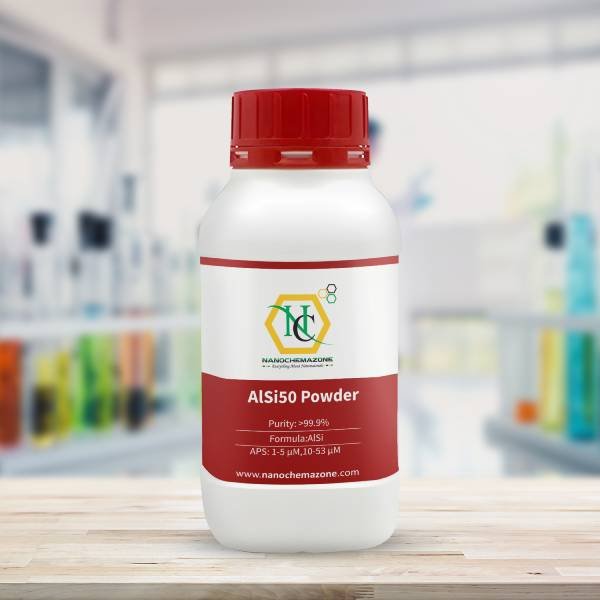
AlSi50 Powder
AlSi50 Powder
| Product | AlSi50 Powder |
| CAS No. | 11145-27-0 |
| Appearance | Gray Metallic Powder |
| Purity | ≥99%, ≥99.9%, ≥95%(Other purities are also available) |
| APS | 1-5 µM, 10-53 µM (Can be customized), Ask for other available size range. |
| Ingredient | AlSi |
| Density | 2.5-2-7g/cm3 |
| Molecular Weight | N/A |
| Product Codes | NCZ-DCY-194/25 |
AlSi50 Description:
AlSi50 Powder is one of the numerous advanced ceramic materials manufactured by Nanochemazone. Nanochemazone produces too many standard grades when applicable, including Mil Spec (military grade); ACS, Reagent and Technical Grade; Food, Agricultural and Pharmaceutical Grade; Optical Grade, USP and EP/BP (European Pharmacopoeia/British Pharmacopoeia) and follows applicable ASTM testing standards. Typical and custom packaging is available. Additional technical, research and safety (MSDS) information are available. Please request a quote above for more information on lead time and pricingAlSi50 Powder Related Information :
Storage Conditions: Airtight sealed, avoid light and keep dry at room temperature. Please contact us for customization and price inquiry Email: contact@nanochemazone.com Note: We supply different size ranges of Nano and micron as per the client’s requirements and also accept customization in various parameters. AlSi50 Powder AlSi50 is an aluminum-silicon alloy powder containing 50% silicon and remainder aluminum. It offers an exceptional combination of properties like low density, high fluidity, low thermal expansion, high specific strength, and corrosion resistance. AlSi50 is an aluminum-silicon alloy powder containing 50% silicon and remainder aluminum. It offers an exceptional combination of properties like low density, high fluidity, low thermal expansion, high specific strength, and corrosion resistance. AlSi50 Powder Composition The typical composition of AlSi50 alloy powder is:| Element | Composition |
| Aluminum (Al) | Balance |
| Silicon (Si) | 48-52% |
| Property | Value |
| Density | 2.55 g/cm3 |
| Melting Point | 577°C |
| Ultimate Tensile Strength | 200-300 MPa |
| Elongation | <1% |
| Hardness | 100-120 HB |
| Thermal Conductivity | 50-90 W/m-K |
| CTE | 12-15 x 10<sup>-6</sup>/°C |
| Young’s Modulus | 80-90 GPa |
| Corrosion Resistance | Excellent |
| Applications | Benefits |
| Automotive components | Low density and excellent castability. |
| Aerospace parts | High specific strength, stable dimensions. |
| Electronic substrates | Thermal management, CTE match with ceramics. |
| Mirror blanks | Low density, machinability, stability. |
| Medical implants | Biocompatible, non-toxic, corrosion resistant. |
| Parameter | Options |
| Particle size | 10 – 150 microns |
| Particle shape | Irregular, spherical |
| Apparent density | Up to 2.7 g/cm3 |
| Flow rate | Up to 25 s/50g |
| Purity | Up to 99.7% |
| Alloy variants | AlSi40, AlSi30 |
| Method | Details |
| Additive manufacturing | Excellent geometric freedom for complex shapes. |
| Metal injection molding | High precision net shape capability. |
| Press and sinter | Economical for higher volume simpler shapes. |
| Casting | Leverages excellent fluidity and mold filling behavior. |
| Extrusion | For profiles, rods and tubes. |
| Heat Treatment | Details | Purpose |
| Solution heat treatment | 500-550°C, quench | Dissolve soluble phases |
| Artificial aging | 150-180°C, 5-10 hrs | Precipitation hardening |
| Stress relieving | 250°C, 2 hrs | Remove residual stresses |
| Alloy | AlSi50 | AlSi40 | AlSi30 |
| Fluidity | Highest | High | Medium |
| Castability | Excellent | Very Good | Good |
| Hardness | High | Medium | Low |
| Strength | High | Medium | Low |
| Thermal Conductivity | Medium | High | Highest |
| CTE | Low | Medium | High |
| Cost | High | Medium | Low |
| Hazard | Precautions | PPE |
| Skin/eye contact | Avoid direct contact. Rinse if exposed. | Gloves, goggles |
| Inhalation | Avoid breathing dust. Ensure ventilation. | Respirator |
| Ingestion | Avoid hand-mouth transfer. Wash hands. | – |
| Fire | Use sand. Do not use water. | Protective gear |
| Parameter | Method | Specification |
| Chemical composition | OES, XRF, wet chemistry | Conformance to Al and Si content |
| Particle size distribution | Laser diffraction, sieving | D10, D50, D90 within range |
| Powder morphology | SEM imaging | Shape and flow characteristics |
| Apparent density | Hall flowmeter test | Minimum specified density |
| Flow rate | Hall flowmeter test | Maximum seconds for 50g flow |
| Impurity levels | ICP or LECO analysis | Low oxygen, moisture content |
- What is AlSi50 used for?
- AlSi50 is ideal for applications like automotive components, aerospace parts, and electronic substrates where low mass, dimensional stability, and high fluidity are critical.
- Does AlSi50 require heat treatment?
- Optional heat treatment including solutionizing and aging can be done to enhance strength by precipitating silicon particles in the microstructure.
- What methods can consolidate AlSi50 powder?
- AlSi50 powder can be consolidated to full density using metal injection molding, casting, additive manufacturing via SLM/EBM, extrusion, and sintering.
- Is AlSi50 readily weldable?
- AlSi50 has relatively poor weldability owing to high silicon content. Special filler material and techniques are required for welding this alloy.
- Is AlSi50 powder safe to handle?
- Like any fine metal powder, standard safety precautions must be taken when handling AlSi50 powder to minimize health and safety risks.
Reviews
There are no reviews yet.