
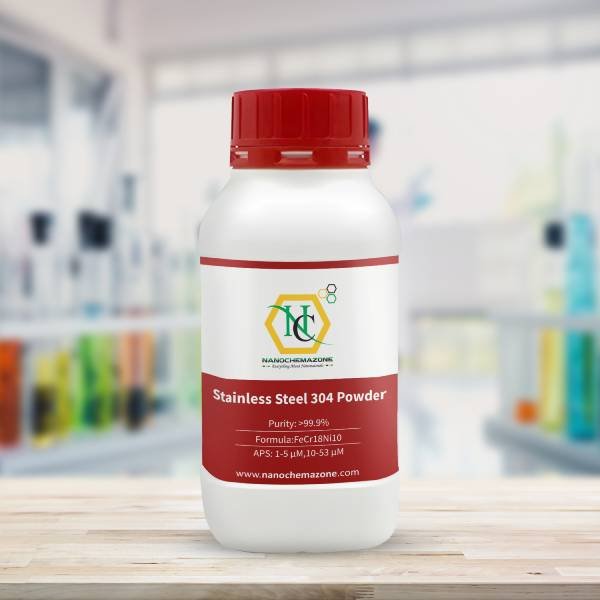


Stainless Steel 304 Powder
$0.00
Stainless Steel 304 Powder
| Product | Stainless Steel 304 Powder |
| CAS No. | 65997-19-5 |
| Appearance | Silver-Gray Powder |
| Purity | ≥99%, ≥99.9%, ≥95%(Other purities are also available) |
| APS | 1-5 µM, 10-53 µM (Can be customized), Ask for other available size range. |
| Ingredient | FeCr18Ni10 |
| Density | 7.9g/cm3 |
| Molecular Weight | N/A |
| Product Codes | NCZ-DCY-253/25 |
Stainless Steel 304 Description:
Stainless Steel 304 Powder is one of the numerous advanced ceramic materials manufactured by Nanochemazone. Nanochemazone produces too many standard grades when applicable, including Mil Spec (military grade); ACS, Reagent and Technical Grade; Food, Agricultural and Pharmaceutical Grade; Optical Grade, USP and EP/BP (European Pharmacopoeia/British Pharmacopoeia) and follows applicable ASTM testing standards. Typical and custom packaging is available. Additional technical, research and safety (MSDS) information are available. Please request a quote above for more information on lead time and pricing
Stainless Steel Powder Related Information :
Storage Conditions:
Airtight sealed, avoid light and keep dry at room temperature.
Please contact us for customization and price inquiry
Email: contact@nanochemazone.com
Note: We supply different size ranges of Nano and micron as per the client’s requirements and also accept customization in various parameters.
stainless steel 304 Powder for 3D Printing
304 powder is a form of stainless steel powder that is widely used in various industries due to its exceptional properties. It is composed of iron, chromium, and nickel, which give it excellent corrosion resistance, high strength, and good formability. The powder form allows for easy processing and customization according to specific requirements.
Introduction To 304 Powder
304 powder is a form of stainless steel powder that is widely used in various industries due to its exceptional properties. It is composed of iron, chromium, and nickel, which give it excellent corrosion resistance, high strength, and good formability. The powder form allows for easy processing and customization according to specific requirements.
Composition And Properties
304 powder primarily consists of iron, with approximately 18% chromium and 8% nickel. These alloying elements contribute to its corrosion resistance and durability. Additionally, it contains small amounts of carbon, manganese, phosphorus, sulfur, and silicon. The combination of these elements results in a material with remarkable mechanical and chemical properties.
Some key properties of 304 powder include:
Corrosion resistance: 304 powder exhibits excellent resistance to corrosion from a wide range of substances, including water, acids, and alkalis.
Strength and durability: It has high tensile strength, making it suitable for applications that require robust and long-lasting components.
Formability: 304 powder can be easily formed into different shapes, allowing for versatility in manufacturing processes.
Heat resistance: It maintains its strength and structural integrity even at elevated temperatures.
Hygienic properties: Due to its non-porous surface, it is easy to clean and maintain sanitary conditions in applications such as food processing.
Industrial Applications
304 powder finds extensive use in various industries. Let’s explore some of its prominent applications:
Automotive Industry
In the automotive sector, 304 powder is utilized in the manufacturing of exhaust systems, mufflers, and other components exposed to corrosive gases and liquids. Its resistance to oxidation and high-temperature environments makes it an ideal choice for these applications, ensuring longevity and reliability.
Food Processing
The food processing industry demands materials that meet stringent hygiene and corrosion resistance requirements. 304 powder is widely employed in food processing equipment, such as tanks, pipes, and fittings. Its smooth surface and resistance to food acids and chemicals make it a preferred choice, ensuring the integrity and safety of food products.
Chemical Industry
304 powder is extensively used in the chemical industry due to its resistance to various corrosive substances. It is employed in the construction of reactors, storage tanks, and pipelines for handling chemicals and acids. The material’s ability to withstand corrosive environments and retain its structural integrity contributes to safe and efficient chemical processes.
Architecture And Construction
In architecture and construction, 304 powder finds applications in the fabrication of structural components, handrails, and decorative elements. Its aesthetic appeal, combined with corrosion resistance, makes it an excellent choice for both interior and exterior applications. Moreover, its formability allows for intricate designs and customization according to architectural requirements.
Aerospace Sector
The aerospace industry requires materials that can withstand extreme conditions, including high temperatures, vibrations, and corrosive environments. 304 powder is utilized in aircraft components, such as exhaust systems, brackets, and fasteners, due to its excellent combination of strength, heat resistance, and corrosion resistance. It plays a vital role in ensuring the safety and reliability of aerospace systems.
Advantages Of Using 304 Powder
304 powder offers several advantages over other materials, making it a preferred choice in many industrial applications. Some notable benefits include:
Corrosion resistance: The high chromium and nickel content provide exceptional resistance to corrosion, ensuring durability and longevity.
Cost-effectiveness: 304 powder offers a cost-effective solution for various applications due to its availability and wide range of uses.
Versatility: Its formability allows for customization and adaptability to different manufacturing processes and design requirements.
Hygienic properties: The non-porous surface of 304 powder makes it easy to clean and maintain in industries with strict hygiene standards.
Recyclability: Stainless steel, including 304 powder, is highly recyclable, contributing to environmental sustainability.
Challenges And Limitations
While 304 powder boasts numerous advantages, it also has some limitations to consider. These include:
Moderate temperature limitations: While it exhibits good heat resistance, prolonged exposure to high temperatures may lead to a reduction in mechanical properties.
Sensitivity to certain chemicals: 304 powder may be susceptible to specific corrosive substances, such as chlorides, under certain conditions. Proper material selection is crucial in such cases.
Magnetic properties: Unlike some stainless steel alloys, 304 powder is generally magnetic, which may impact its suitability for certain applications.
Best Practices For Handling And Storage
To maximize the performance and longevity of 304 powder, it is important to follow best practices for its handling and storage. Consider the following guidelines:
Store the powder in a clean, dry, and well-ventilated area to prevent moisture and contamination.
Handle the powder with clean gloves to avoid transferring oils and other substances that may affect its properties.
Keep the powder away from strong acids, alkalis, and chloride-containing substances to minimize the risk of corrosion.
Regularly inspect the powder for any signs of damage or contamination before use.
Future Trends And Innovations
As technology advances and new industrial challenges emerge, the development of stainless steel powders like 304 powder continues. Researchers and manufacturers are exploring ways to further enhance its properties, expand its applications, and optimize its processing techniques. Future trends may include improved heat resistance, increased strength, and the development of eco-friendly manufacturing processes.
for your specific needs.
Frequently Asked Questions (FAQs)
Is 304 powder suitable for outdoor applications?
Yes, 304 powder is commonly used in outdoor applications due to its corrosion resistance and durability. However, prolonged exposure to harsh environments may require additional protective measures.
Can 304 powder be welded?
Yes, 304 powder can be welded using common welding techniques. However, it is important to follow proper welding procedures to ensure optimal results and maintain its corrosion resistance.
Can 304 powder be used for medical applications?
While 304 powder is not typically used for direct medical implants, it is often employed in medical equipment and devices where corrosion resistance is required, such as surgical instruments and hospital equipment.
How does 304 powder compare to other stainless steel alloys?
304 powder is one of the most commonly used stainless steel alloys due to its balanced combination of properties, cost-effectiveness, and availability. However, there are other alloys with specialized properties that may be more suitable for specific applications.
Is 304 powder recyclable?
Yes, stainless steel, including 304 powder, is highly recyclable. Recycling stainless steel helps conserve resources and reduce environmental impact.
Description
Note: For pricing & ordering information, please get in touch with us at sales@nanochemazone.com
Please contact us for quotes on Larger Quantities and customization. E-mail: contact@nanochemazone.com
Customization:
If you are planning to order large quantities for your industrial and academic needs, please note that customization of parameters (such as size, length, purity, functionalities, etc.) is available upon request.
NOTE:
Images, pictures, colors, particle sizes, purity, packing, descriptions, and specifications for the real and actual goods may differ. These are only used on the website for the purposes of reference, advertising, and portrayal. Please contact us via email at sales@nanochemazone.com or by phone at (+1 780 612 4177) if you have any questions.
Only logged in customers who have purchased this product may leave a review.
Related products

317L Powder
317L Powder
| Product | 317L Powder |
| CAS No. | 12597-67-6 |
| Appearance | Silvery Powder |
| Purity | ≥99%, ≥99.9%, ≥95%(Other purities are also available) |
| APS | 1-5 µM, 10-53 µM (Can be customized), Ask for other available size range. |
| Ingredient | Fe-18Cr-12Ni-3Mo |
| Density | 7.9g/cm3 |
| Molecular Weight | 150-160 g/mol |
| Product Codes | NCZ-DCY-172/25 |
317L Description:
317L Powder is one of the numerous advanced ceramic materials manufactured by Nanochemazone. Nanochemazone produces too many standard grades when applicable, including Mil Spec (military grade); ACS, Reagent and Technical Grade; Food, Agricultural and Pharmaceutical Grade; Optical Grade, USP and EP/BP (European Pharmacopoeia/British Pharmacopoeia) and follows applicable ASTM testing standards. Typical and custom packaging is available. Additional technical, research and safety (MSDS) information are available. Please request a quote above for more information on lead time and pricing317L Powder Related Information :
Storage Conditions: Airtight sealed, avoid light and keep dry at room temperature. Please contact us for customization and price inquiry Email: contact@nanochemazone.com Note: We supply different size ranges of Nano and micron as per the client’s requirements and also accept customization in various parameters. 317L Powder 317L powder is an austenitic stainless steel powder containing 18% chromium, 3% molybdenum, and 0.08% carbon. It offers an excellent combination of corrosion resistance, strength, weldability and cost. Overview of 317L Powder 317L powder is an austenitic stainless steel powder containing 18% chromium, 3% molybdenum, and 0.08% carbon. It offers an excellent combination of corrosion resistance, strength, weldability and cost. Key properties and advantages of 317L powder include: 317L Powder Properties and Characteristics| Properties | Details |
| Composition | Fe-18Cr-3Mo-0.08C alloy |
| Density | 8.0 g/cc |
| Particle shape | Irregular, angular |
| Size range | 10-150 microns |
| Apparent density | Up to 50% of true density |
| Flowability | Moderate |
| Corrosion resistance | Excellent in many environments |
| Strengthening | Cold working and solid solution strengthening |
| Element | Weight % |
| Iron (Fe) | Balance |
| Chromium (Cr) | 17-19% |
| Nickel (Ni) | 11-15% |
| Molybdenum (Mo) | 2.5-3.5% |
| Manganese (Mn) | <2% |
| Carbon (C) | 0.08% max |
| Silicon (Si) | 1% max |
| Nitrogen (N) | 0.10% max |
| Sulfur (S) | 0.03% max |
| Property | Values |
| Density | 8.0 g/cc |
| Melting point | 1370-1400°C |
| Electrical resistivity | 0.8 μΩ-m |
| Thermal conductivity | 16 W/mK |
| Thermal expansion | 16 x 10^-6 /K |
| Maximum service temperature | 900°C |
| Property | Values |
| Tensile strength | 515-620 MPa |
| Yield strength | 205-275 MPa |
| Elongation | 40-50% |
| Hardness | 88-95 HRB |
| Impact strength | 100-150 J |
| Modulus of elasticity | 190-210 GPa |
| Industry | Example Uses |
| Chemical | Tanks, valves, pipes, pumps |
| Petrochemical | Process equipment, tubing, valves |
| Marine | Propeller shafts, fasteners, deck hardware |
| Nuclear | Reactor vessels, fuel element cladding |
| Architectural | Railings, wall panels, roofing |
| Standard | Description |
| ASTM A276 | Standard for stainless steel bars and shapes |
| ASTM A479 | Standard for stainless steel tubing |
| AMS 5524 | Annealed stainless steel bar, wire, forgings |
| ASME SA-276 | Specification for stainless steel bars and shapes |
| AISI 630 | Standard for 17Cr-4Ni precipitation hardening stainless steel |
| Particle Size | Characteristics |
| 10-45 microns | Ultrafine grade for high density and surface finish |
| 45-150 microns | Coarse grade provides good flowability |
| 15-150 microns | Standard grade for pressing and sintering |
| Apparent Density | Details |
| Up to 50% of true density | For irregular powder morphology |
| 4.5-5.5 g/cc typical | Improves with greater packing density |
| Method | Details |
| Gas atomization | High pressure inert gas breaks molten metal stream into fine droplets |
| Water atomization | High pressure water jet breaks metal into fine particles |
| Vacuum induction melting | High purity input materials melted under vacuum |
| Multiple remelting | Improves chemical homogenization |
| Sieving | Classifies powder into different particle size ranges |
| Recommendation | Reason |
| Use PPE and ventilation | Avoid exposure to fine metallic particles |
| Ensure proper grounding | Prevent static discharge while handling |
| Avoid ignition sources | Powder can combust in oxygen atmosphere |
| Use non-sparking tools | Prevent possibility of ignition |
| Follow safety protocols | Reduce risk of burns, inhalation, ingestion |
| Store in stable containers | Prevent contamination or oxidation |
| Test | Details |
| Chemical analysis | ICP and XRF verify composition |
| Particle size distribution | Laser diffraction determines size distribution |
| Apparent density | Hall flowmeter test per ASTM B212 standard |
| Powder morphology | SEM imaging shows particle shape |
| Flow rate analysis | Gravity flow rate through specified nozzle |
| Loss on ignition | Determines residual moisture content |
| Parameter | 317L | 316L |
| Density | 8.0 g/cc | 8.0 g/cc |
| Strength | 515-620 MPa | 485-550 MPa |
| Corrosion resistance | Excellent | Outstanding |
| Pitting resistance | Very good | Excellent |
| Cost | Low | High |
| Uses | Process industry, marine | Chemical, pharmaceutical |
420 Powder
420 Powder
| Product | 420 Powder |
| CAS No. | 73665-45-9 |
| Appearance | Silvery Powder |
| Purity | ≥99%, ≥99.9%, ≥95%(Other purities are also available) |
| APS | 1-5 µM, 10-53 µM (Can be customized), Ask for other available size range. |
| Ingredient | Fe-12Cr-0.3C |
| Density | 7.7g/cm3 |
| Molecular Weight | 15-66g/mol |
| Product Codes | NCZ-DCY-173/25 |
420 Description:
420 Powder is one of the numerous advanced ceramic materials manufactured by Nanochemazone. Nanochemazone produces too many standard grades when applicable, including Mil Spec (military grade); ACS, Reagent and Technical Grade; Food, Agricultural and Pharmaceutical Grade; Optical Grade, USP and EP/BP (European Pharmacopoeia/British Pharmacopoeia) and follows applicable ASTM testing standards. Typical and custom packaging is available. Additional technical, research and safety (MSDS) information are available. Please request a quote above for more information on lead time and pricing420 Powder Related Information :
Storage Conditions: Airtight sealed, avoid light and keep dry at room temperature. Please contact us for customization and price inquiry Email: contact@nanochemazone.com Note: We supply different size ranges of Nano and micron as per the client’s requirements and also accept customization in various parameters. 420 powder 316L is an austenitic stainless steel. The Mo content of 316L gives it excellent corrosion resistance 17-4PH is a martensitic precipitation hardening stainless steel with high strength, hardness and corrosion resistance. 420 is a martensitic stainless steel with good mechanical properties, thermal conductivity and polishing properties similar to mold steel, while maintaining good corrosion resistance. 316L is an austenitic stainless steel. The Mo content of 316L gives it excellent corrosion resistance 17-4PH is a martensitic precipitation hardening stainless steel with high strength, hardness and corrosion resistance. 420 is a martensitic stainless steel with good mechanical properties, thermal conductivity and polishing properties similar to mold steel, while maintaining good corrosion resistance. Physical properties| Trademark | Size range | Size distribution | Hall flow rate | Bulk density | Tap density | ||
| D10(μm) | D50(μm) | D90(μm) | |||||
| 316L | 15-53μm | 17-23 | 30-38 | 50-58 | 25s/50g | 4.0g/cm³ | 4.5g/cm³ |
| 17-4PH | 15-53μm | 4.0g/cm³ | 4.5g/cm³ | ||||
| 420 | 15-53μm | 4.0g/cm³ | 4.5g/cm³ | ||||
| Trademark | Heat treatment recommendations |
| 316L | 1050℃/2h/WQ |
| 17-4PH | 1040°C/2h +480°C/4h |
| 420 | 1050°C/0.5h/WQ |
| Trademark | Hardness(HRC) | Tensile strength (σb/Mpa) | Yield strength (σp0.2/Mpa) | Elongation (δ5/%) |
| 316L | 13-15 | 650 | 550 | 45 |
| 17-4PH | 32-42 | 1310 | 1175 | 13 |
| 420 | 48-52 | 1950 | 1530 | 7 |
| Trademark | C | Cr | Ni | Cu | Nb | Mo |
| 316L | ≤0.03 | 16.00-18.00 | 10.00-14.00 | – | – | 2.00-3.00 |
| 17-4PH | ≤0.03 | 15.5-17.5 | 3.00-5.00 | 3.00-5.00 | 0.15-0.45 | – |
| 420 | 0.35-0.45 | 12.00-14.00 | ≤0.6 | – | ≤0.20 | ≤0.20 |
| Trademark | Si | Mn | S | P | O | Fe |
| 316L | ≤1.00 | ≤2.00 | ≤0.03 | ≤0.045 | ≤0.08 | Bal |
| 17-4PH | ≤1.00 | ≤1.00 | ≤0.03 | ≤0.03 | ≤0.03 | Bal |
| 420 | ≤1.00 | ≤1.00 | ≤0.03 | ≤0.045 | ≤0.03 | Bal |

430L Powder
430L Powder
| Product | 430L Powder |
| CAS No. | 12597-68-1 |
| Appearance | Silvery or Gray Powder |
| Purity | ≥99%, ≥99.9%, ≥95%(Other purities are also available) |
| APS | 1-5 µM, 10-53 µM (Can be customized), Ask for other available size range. |
| Ingredient | Fe-16Cr |
| Density | 7.7g/cm3 |
| Molecular Weight | 150-160 g/mol |
| Product Codes | NCZ-DCY-174/25 |
430L Description:
430L Powder is one of the numerous advanced ceramic materials manufactured by Nanochemazone. Nanochemazone produces too many standard grades when applicable, including Mil Spec (military grade); ACS, Reagent and Technical Grade; Food, Agricultural and Pharmaceutical Grade; Optical Grade, USP and EP/BP (European Pharmacopoeia/British Pharmacopoeia) and follows applicable ASTM testing standards. Typical and custom packaging is available. Additional technical, research and safety (MSDS) information are available. Please request a quote above for more information on lead time and pricing430L Powder Related Information :
Storage Conditions: Airtight sealed, avoid light and keep dry at room temperature. Please contact us for customization and price inquiry Email: contact@nanochemazone.com Note: We supply different size ranges of Nano and micron as per the client’s requirements and also accept customization in various parameters. 430L Powder 430L powder is a ferritic stainless steel powder containing 17% chromium with additions of molybdenum and niobium for enhanced corrosion resistance. It provides an optimal balance of corrosion resistance, strength, weldability and cost. Overview of 430L Powder 430L powder is a ferritic stainless steel powder containing 17% chromium with additions of molybdenum and niobium for enhanced corrosion resistance. It provides an optimal balance of corrosion resistance, strength, weldability and cost. Key properties and advantages of 430L powder: 430L Powder Properties and Characteristics| Properties | Details |
| Composition | Fe-17Cr-Nb-Mo alloy |
| Density | 7.7 g/cc |
| Particle shape | Irregular, angular |
| Size range | 10-150 microns |
| Apparent density | Up to 50% of true density |
| Flowability | Moderate |
| Corrosion resistance | Excellent in many environments |
| Strengthening | Solid solution and precipitation strengthening |
| Element | Weight % |
| Iron (Fe) | Balance |
| Chromium (Cr) | 16-18% |
| Carbon (C) | 0.12% max |
| Silicon (Si) | 1% max |
| Manganese (Mn) | 1% max |
| Molybdenum (Mo) | 0.5% max |
| Niobium (Nb) | 0.3-0.6% |
| Nitrogen (N) | 0.03% max |
| Sulfur (S) | 0.03% max |
| Property | Values |
| Density | 7.7 g/cc |
| Melting point | 1400-1450°C |
| Electrical resistivity | 0.6-0.7 μΩ-m |
| Thermal conductivity | 26 W/mK |
| Curie temperature | 1440°C |
| Maximum service temperature | 650-750°C |
| Property | Values |
| Tensile strength | 450-650 MPa |
| Yield strength | 250-350 MPa |
| Elongation | 35-45% |
| Modulus of elasticity | 190-210 GPa |
| Hardness | 80-90 HRB |
| Impact strength | 50-100 J |
| Industry | Example Uses |
| Chemical | Tanks, valves, pipes, pumps |
| Automotive | Exhaust components, fuel injection parts |
| Construction | Cladding, architectural features |
| Oil and gas | Wellhead equipment, drilling tools |
| Manufacturing | Pressing tooling, molds, dies |
| Standard | Description |
| ASTM A743 | Standard for corrosion resistant chromium steel castings |
| ASTM A744 | Standard for corrosion resistant chromium steel sheet and strip |
| AMS 5759 | Annealed corrosion resistant steel bar, wire, forgings |
| SAE J405 | Automotive weathering steel sheet |
| DIN 17440 | Stainless steels for corrosion resistant applications |
| Particle Size | Characteristics |
| 10-45 microns | Ultrafine grade for high density and surface finish |
| 45-150 microns | Coarse grade provides good flowability |
| 15-150 microns | Standard grade for pressing and sintering |
| Apparent Density | Details |
| Up to 50% of true density | For irregular powder morphology |
| 3.5-4.5 g/cc typical | Improves with greater packing density |
| Method | Details |
| Gas atomization | High pressure inert gas breaks molten metal stream into fine droplets |
| Water atomization | High pressure water jet breaks metal into fine particles |
| Vacuum induction melting | High purity input materials melted under vacuum |
| Multiple remelting | Improves chemical homogenization |
| Sieving | Classifies powder into different particle size ranges |
| Recommendation | Reason |
| Use PPE and ventilation | Avoid exposure to fine metallic particles |
| Ensure proper grounding | Prevent static discharge while handling |
| Avoid ignition sources | Powder can combust in oxygen atmosphere |
| Use non-sparking tools | Prevent possibility of ignition during handling |
| Follow safety protocols | Reduce risk of burns, inhalation, and ingestion |
| Store in stable containers | Prevent contamination or oxidation |
| Test | Details |
| Chemical analysis | ICP and XRF verify composition |
| Particle size distribution | Laser diffraction determines size distribution |
| Apparent density | Hall flowmeter test per ASTM B212 standard |
| Powder morphology | SEM imaging shows particle shape |
| Flow rate analysis | Gravity flow rate through specified nozzle |
| Loss on ignition | Determines residual moisture content |
| Parameter | 430L | 304L |
| Density | 7.7 g/cc | 8.0 g/cc |
| Strength | 450-650 MPa | 520-620 MPa |
| Corrosion resistance | Excellent | Outstanding |
| Heat resistance | Good | Excellent |
| Weldability | Good | Excellent |
| Cost | Low | High |
| Uses | Automotive, construction | Chemical processing, marine |

Al 2024 Powder
Al 2024 Powder
| Product | Al 2024 Powder |
| CAS No. | 7429-90-5 |
| Appearance | Silvery or Metallic Powder |
| Purity | ≥99%, ≥99.9%, ≥95%(Other purities are also available) |
| APS | 1-5 µM, 10-53 µM (Can be customized), Ask for other available size range. |
| Ingredient | Al-4.4Cu-1.5Mg-0.6Mn |
| Density | 2.78g/cm3 |
| Molecular Weight | 110-120g/mol |
| Product Codes | NCZ-DCY-178/25 |
Al 2024 Description:
Al 2024 Powder is one of the numerous advanced ceramic materials manufactured by Nanochemazone. Nanochemazone produces too many standard grades when applicable, including Mil Spec (military grade); ACS, Reagent and Technical Grade; Food, Agricultural and Pharmaceutical Grade; Optical Grade, USP and EP/BP (European Pharmacopoeia/British Pharmacopoeia) and follows applicable ASTM testing standards. Typical and custom packaging is available. Additional technical, research and safety (MSDS) information are available. Please request a quote above for more information on lead time and pricingAl 2024 Powder Related Information :
Storage Conditions: Airtight sealed, avoid light and keep dry at room temperature. Please contact us for customization and price inquiry Email: contact@nanochemazone.com Note: We supply different size ranges of Nano and micron as per the client’s requirements and also accept customization in various parameters. Al 2024 powder Al 2024 powder is an aluminum alloy that primarily consists of aluminum, copper, and small amounts of magnesium and manganese. This alloy exhibits exceptional strength and excellent fatigue resistance, making it ideal for applications where lightweight materials with high mechanical properties are required. Al 2024 powder is commonly used in industries such as aerospace, automotive, and sporting goods. Overview of Al 2024 Powder Al 2024 is one of the most popular 2000 series wrought aluminum alloys known for its strength, fatigue resistance, and excellent machinability and corrosion resistance. The copper additions impart substantial strengthening through precipitation hardening while retaining formability and weldability. Key characteristics of Al 2024 powder include: High strength with moderate ductility and toughness Excellent fatigue and fracture resistance Very good machinability and polishability Good weldability and formability High thermal and electrical conductivity Available in range of powder sizes and shapes Al 2024 powder is suitable for aerospace components and other high-performance applications needing strength combined with fabrication capabilities. Chemical Composition of Al 2024 Powder| Element | Weight % |
| Aluminum (Al) | 90.7-94.7% |
| Copper (Cu) | 3.8-4.9% |
| Magnesium (Mg) | 1.2-1.8% |
| Manganese (Mn) | 0.3-0.9% |
| Iron (Fe) | 0-0.5% |
| Silicon (Si) | 0-0.5% |
| Zinc (Zn) | 0-0.25% |
| Chromium (Cr) | 0-0.1% |
| Titanium (Ti) | 0-0.15% |
| Property | Value |
| Density | 2.77 g/cm3 |
| Melting Point | 500-638°C |
| Thermal Conductivity | 121-190 W/mK |
| Electrical Conductivity | 26-35% IACS |
| Young’s Modulus | 73 GPa |
| Poisson’s Ratio | 0.33 |
| Tensile Strength | 400-500 MPa |
| Yield Strength | 290-385 MPa |
| Elongation | 8-20% |
| Hardness | 90-150 Vickers |
| Parameter | Al 2024 | Al 7075 |
| Alloy type | Heat treatable | Heat treatable |
| Cu content | 3.8-4.9% | 1.2-2% |
| Zn content | 0-0.25% | 5.1-6.1% |
| Strength | High | Very high |
| Fracture toughness | Higher | Moderate |
| Corrosion resistance | Good | Moderate |
| Weldability | Fair | Poor |
| Cost | Lower | Higher |

Al 3003 Powder
Al 3003 Powder
| Product | Al 3003 Powder |
| CAS No. | 7429-90-5 |
| Appearance | Gray Metallic Powder |
| Purity | ≥99%, ≥99.9%, ≥95%(Other purities are also available) |
| APS | 1-5 µM, 10-53 µM (Can be customized), Ask for other available size range. |
| Ingredient | Al-1.2Mn-0.12Cu |
| Density | 2.73g/cm3 |
| Molecular Weight | 27g/mol |
| Product Codes | NCZ-DCY-179/25 |
Al 3003 Description:
Al 3003 Powder is one of the numerous advanced ceramic materials manufactured by Nanochemazone. Nanochemazone produces too many standard grades when applicable, including Mil Spec (military grade); ACS, Reagent and Technical Grade; Food, Agricultural and Pharmaceutical Grade; Optical Grade, USP and EP/BP (European Pharmacopoeia/British Pharmacopoeia) and follows applicable ASTM testing standards. Typical and custom packaging is available. Additional technical, research and safety (MSDS) information are available. Please request a quote above for more information on lead time and pricingAl 3003 Powder Related Information :
Storage Conditions: Airtight sealed, avoid light and keep dry at room temperature. Please contact us for customization and price inquiry Email: contact@nanochemazone.com Note: We supply different size ranges of Nano and micron as per the client’s requirements and also accept customization in various parameters. Al 3003 powder Al 3003 powder is an aluminum alloy powder composed mainly of aluminum and manganese. It belongs to the 3xxx series of aluminum alloys, which are known for their excellent workability and corrosion resistance. The powder form allows for easy handling and processing, making it suitable for various manufacturing techniques. Overview of Al 3003 Powder Al 3003 or 3A21 aluminum is a wrought alloy known for its good cold formability, weldability and corrosion resistance. The manganese additions enhance strength through solid solution strengthening while maintaining workability. Key characteristics of Al 3003 powder include: Moderate strength with good ductility Excellent formability and weldability Good corrosion resistance High thermal and electrical conductivity Low density Available in a range of powder sizes and shapes Al 3003 powder is used widely in chemical tanks, pipeline, automotive parts, heat exchangers, utensils, and other applications needing moderate strength, formability and corrosion resistance. Chemical Composition of Al 3003 Powder| Element | Weight % |
| Aluminum (Al) | Balance |
| Manganese (Mn) | 1.0-1.5% |
| Iron (Fe) | 0.7% max |
| Silicon (Si) | 0.6% max |
| Copper (Cu) | 0.05-0.20% |
| Zinc (Zn) | 0.10% max |
| Magnesium (Mg) | 0.10% max |
| Chromium (Cr) | 0.10% max |
| Property | Value |
| Density | 2.73 g/cm3 |
| Melting Point | 645-650°C |
| Thermal Conductivity | 180 W/mK |
| Electrical Conductivity | 43-44% IACS |
| Young’s Modulus | 68-72 GPa |
| Poisson’s Ratio | 0.33 |
| Tensile Strength | 145-185 MPa |
| Yield Strength | 110-140 MPa |
| Elongation | 12-20% |
| Hardness | 35-55 Brinell |
| Parameter | Al 3003 | Al 6061 |
| Alloy type | Non-heat treatable | Heat treatable |
| Mn content | 1.0-1.5% | 0.15% max |
| Mg content | 0.1% max | 0.8-1.2% |
| Strength | Moderate | Higher |
| Corrosion resistance | Good | Excellent |
| Weldability | Excellent | Good |
| Cost | Lower | Higher |
| Applications | Chemical tanks, utensils | Aerospace, automotive parts |
Al 3203 Powder
Al 3203 Powder
| Product | Al 3203 Powder |
| CAS No. | 7429-90-5 |
| Appearance | Silvery-Gray Metallic Powder |
| Purity | ≥99%, ≥99.9%, ≥95%(Other purities are also available) |
| APS | 1-5 µM, 10-53 µM (Can be customized), Ask for other available size range. |
| Ingredient | Al2O3 |
| Density | 2.7g/cm3 |
| Molecular Weight | 27g/mol |
| Product Codes | NCZ-DCY-186/25 |
Al 3203 Description:
Al 3203 Powder is one of the numerous advanced ceramic materials manufactured by Nanochemazone. Nanochemazone produces too many standard grades when applicable, including Mil Spec (military grade); ACS, Reagent and Technical Grade; Food, Agricultural and Pharmaceutical Grade; Optical Grade, USP and EP/BP (European Pharmacopoeia/British Pharmacopoeia) and follows applicable ASTM testing standards. Typical and custom packaging is available. Additional technical, research and safety (MSDS) information are available. Please request a quote above for more information on lead time and pricingAl 3203 Powder Related Information :
Storage Conditions: Airtight sealed, avoid light and keep dry at room temperature. Please contact us for customization and price inquiry Email: contact@nanochemazone.com Note: We supply different size ranges of Nano and micron as per the client’s requirements and also accept customization in various parameters. Al 3203 powder Al2O3 powder is an aluminum alloy composed of aluminum, copper, and manganese. It is renowned for its excellent strength and high fatigue resistance, making it an ideal choice for demanding environments and structural components. The precise composition and manufacturing process of Al 3203 powder ensure consistent quality and performance, making it a reliable material for numerous applications. Overview of Al2O3 Powder Al2O3 or aluminum oxide is a ceramic material known for its high hardness, excellent dielectric properties, refractoriness, abrasion and corrosion resistance. Alumina powder is the powder form of aluminum oxide used in a variety of applications. Key properties of Al2O3 powder include: High hardness and wear resistance High melting point of over 2000°C Low electrical and thermal conductivity Excellent thermal shock resistance Resistant to strong acids and alkalis Low density around 3.95 g/cm3 Chemically inert material White color powder available in various particle sizes Chemical Composition of Al2O3 Powder| Compound | Formula | Weight % |
| Aluminum oxide | Al2O3 | 99.5% min |
| Silicon dioxide | SiO2 | 0.05% max |
| Iron oxide | Fe2O3 | 0.08% max |
| Titanium dioxide | TiO2 | 0.03% max |
| Sodium oxide | Na2O | 0.05% max |
| Magnesium oxide | MgO | 0.03% max |
| Property | Value |
| Melting point | 2050°C |
| Density | 3.95 g/cm3 |
| Hardness | 9 Mohs |
| Flexural strength | 330 MPa |
| Compressive strength | 2600 MPa |
| Porosity | <1% |
| Thermal conductivity | 30 W/m.K |
| Electrical resistivity | >1014 ohm.cm |
| Dielectric strength | 15-35 kV/mm |
| Water absorption | 0% |
| Parameter | α-Al2O3 | γ-Al2O3 |
| Crystal structure | Hexagonal | Cubic |
| Density | 3.95 g/cm3 | 3.65 g/cm3 |
| Hardness | 9 Mohs | 8 Mohs |
| Melting point | 2050°C | ~1100°C |
| Thermal conductivity | 30 W/m.K | 5-10 W/m.K |
| Surface area | <10 m2/g | 100-300 m2/g |
| Applications | Abrasives, ceramics | Catalysts, adsorbents |
| Price | Lower | Higher |

Al 7075 Powder
Al 7075 Powder
| Product | Al 7075 Powder |
| CAS No. | 7429-90-5 |
| Appearance | Gray Metallic Powder |
| Purity | ≥99%, ≥99.9%, ≥95%(Other purities are also available) |
| APS | 1-5 µM, 10-53 µM (Can be customized), Ask for other available size range. |
| Ingredient | Al-5.6Zn-2.5Mg-1.6Cu |
| Density | 2.81g/cm3 |
| Molecular Weight | 270g/mol |
| Product Codes | NCZ-DCY-179/25 |
Al 7075 Description:
Al 7075 Powder is one of the numerous advanced ceramic materials manufactured by Nanochemazone. Nanochemazone produces too many standard grades when applicable, including Mil Spec (military grade); ACS, Reagent and Technical Grade; Food, Agricultural and Pharmaceutical Grade; Optical Grade, USP and EP/BP (European Pharmacopoeia/British Pharmacopoeia) and follows applicable ASTM testing standards. Typical and custom packaging is available. Additional technical, research and safety (MSDS) information are available. Please request a quote above for more information on lead time and pricingAl 7075 Powder Related Information :
Storage Conditions: Airtight sealed, avoid light and keep dry at room temperature. Please contact us for customization and price inquiry Email: contact@nanochemazone.com Note: We supply different size ranges of Nano and micron as per the client’s requirements and also accept customization in various parameters. Al 7075 powder Al 7075 powder is a high-strength aluminum alloy composed primarily of aluminum, zinc, copper, and small amounts of magnesium and chromium. It is renowned for its impressive mechanical properties, making it an ideal choice for applications that require strength, durability, and lightweight characteristics. Al 7075 powder is typically produced through a process called atomization, where molten aluminum is sprayed and solidified into fine powder particles. Overview of Al 7075 Powder Al 7075 is one of the highest strength 7000 series aluminum alloys, offering strength superior to many steels. Zinc is the main alloying addition while magnesium imparts strength through precipitation hardening. Key properties of Al 7075 powder include: Exceptionally high tensile and yield strength High hardness and good fatigue strength Good toughness and moderate ductility Excellent finishing characteristics High corrosion resistance Available in range of powder sizes and shapes Al 7075 powder is ideal for high-performance aerospace and defense components needing the optimal combination of strength, hardness, fatigue resistance, and moderate weldability. Chemical Composition of Al 7075 Powder| Element | Weight % |
| Aluminum (Al) | 87.1-91.4% |
| Zinc (Zn) | 5.1-6.1% |
| Magnesium (Mg) | 2.1-2.9% |
| Copper (Cu) | 1.2-2.0% |
| Iron (Fe) | 0-0.5% |
| Silicon (Si) | 0-0.4% |
| Manganese (Mn) | 0-0.3% |
| Chromium (Cr) | 0.18-0.28% |
| Titanium (Ti) | 0-0.2% |
| Property | Value |
| Density | 2.81 g/cm3 |
| Melting Point | 477–635°C |
| Thermal Conductivity | 130–210 W/mK |
| Electrical Conductivity | 22-30% IACS |
| Young’s Modulus | 71–72 GPa |
| Poisson’s Ratio | 0.33 |
| Tensile Strength | 570–635 MPa |
| Yield Strength | 505–570 MPa |
| Elongation | 7–10% |
| Hardness | 150–190 Brinell |
| Parameter | Al 7075 | Al 6061 |
| Alloy type | Heat treatable | Heat treatable |
| Zn content | 5.1-6.1% | 0% |
| Mg content | 2.1-2.9% | 0.8-1.2% |
| Strength | Much higher | Moderate |
| Machinability | Poor | Excellent |
| Weldability | Poor | Very good |
| Corrosion resistance | Moderate | Excellent |
| Cost | Higher | Lower |

AlSi10 Powder
AlSi10 Powder
| Product | AlSi10 Powder |
| CAS No. | N/A |
| Appearance | Gray-Silver Metallic Powder |
| Purity | ≥99%, ≥99.9%, ≥95%(Other purities are also available) |
| APS | 1-5 µM, 10-53 µM (Can be customized), Ask for other available size range. |
| Ingredient | Al90Si10 |
| Density | 2.67g/cm3 |
| Molecular Weight | N/A |
| Product Codes | NCZ-DCY-190/25 |
AlSi10 Description:
AlSi10 Powder is one of the numerous advanced ceramic materials manufactured by Nanochemazone. Nanochemazone produces too many standard grades when applicable, including Mil Spec (military grade); ACS, Reagent and Technical Grade; Food, Agricultural and Pharmaceutical Grade; Optical Grade, USP and EP/BP (European Pharmacopoeia/British Pharmacopoeia) and follows applicable ASTM testing standards. Typical and custom packaging is available. Additional technical, research and safety (MSDS) information are available. Please request a quote above for more information on lead time and pricingALSi10 Powder Related Information :
Storage Conditions: Airtight sealed, avoid light and keep dry at room temperature. Please contact us for customization and price inquiry Email: contact@nanochemazone.com Note: We supply different size ranges of Nano and micron as per the client’s requirements and also accept customization in various parameters. AlSi10 Powder AlSi10 is an aluminum alloy powder containing 10% silicon and remainder aluminum. It offers an excellent combination of strength, low density, thermal properties, corrosion resistance and weldability. AlSi10 Powder Composition| Element | Composition |
| Aluminum (Al) | Balance |
| Silicon (Si) | 9-11% |
| Property | Value |
| Density | 2.7 g/cm3 |
| Melting Point | ~600°C |
| Thermal Conductivity | 150-180 W/m-K |
| Electrical Conductivity | 35-40% IACS |
| Coefficient of Thermal Expansion | 21-23 x 10<sup>-6</sup> /°C |
| Modulus of Elasticity | 80-85 GPa |
| Tensile Strength | 240-300 MPa |
| Elongation | 1-5% |
| Hardness | 80-90 Brinell |
| Corrosion Resistance | Excellent |
| Applications | Benefits |
| Aerospace components | Low density combined with high strength. |
| Automotive parts | Weight reduction without compromising mechanical performance. |
| Electronic housings | Thermal management for heat dissipation combined with low weight. |
| Medical implants | Biocompatible, non-toxic, corrosion resistant. |
| Thermal management | High thermal conductivity to dissipate heat. |
| Parameter | Options |
| Particle size | 5-150 microns |
| Particle shape | Spherical, irregular |
| Apparent density | Up to 2.7 g/cm3 |
| Flow rate | Up to 25 s/50g |
| Purity | Up to 99.7% |
| Alloy variants | AlSi12, AlSi5 |
| Method | Benefits |
| Additive manufacturing | Excellent geometric freedom for complex shapes. |
| Metal injection molding | High precision net shape capability. |
| Pressing and sintering | Economical for high volume simpler geometries. |
| Extrusion | Continuous production of rods and tubes. |
| Isostatic pressing | Achieves full density and improves properties. |
| Heat Treatment | Details | Purpose |
| Solutionizing | 530-550°C, quench | Dissolve soluble phases |
| Artificial Aging | 150-180°C, 5-10 hrs | Precipitation hardening |
| Annealing | 350°C, slow cooling | Restores ductility |
| Alloy | AlSi10 | AlSi12 | Al6061 | Al7075 |
| Strength | High | Highest | Medium | Very High |
| Weldability | Excellent | Poor | Good | Poor |
| Corrosion Resistance | Excellent | Excellent | Excellent | Good |
| Thermal Conductivity | High | Medium | Medium | Low |
| Density | Low | Low | Low | Low |
| Cost | Low | High | Medium | High |
| Hazard | Precautions | PPE |
| Skin/eye contact | Avoid direct contact. Rinse if exposed. | Gloves, goggles |
| Inhalation | Avoid breathing dust. Ensure ventilation. | Respirator |
| Ingestion | Avoid hand-mouth transfer. Wash hands. | – |
| Fire | Use sand. Do not use water. | Protective gear |
| Parameter | Method | Specification |
| Chemical composition | OES, XRF, wet chemistry | Conformance to Al, Si, Mg content |
| Particle size distribution | Laser diffraction, sieving | D10, D50, D90 within range |
| Powder morphology | SEM imaging | Spherical shape and flowability |
| Apparent density | Hall flowmeter test | Minimum specified density |
| Flow rate | Hall flow meter test | Maximum flow seconds |
| Impurity levels | ICP or LECO analysis | Low oxygen, moisture content |
- What is AlSi10 alloy used for?
- AlSi10 is widely used in aerospace, automotive, and electronics applications where low weight and high strength are critical such as engine mounts, pistons, housings, heat sinks.
- Does AlSi10 require heat treatment?
- Yes, solution heat treatment followed by aging can significantly enhance the tensile strength by precipitating alloying elements like silicon.
- What methods can consolidate AlSi10 powder?
- AlSi10 powder can be consolidated to full density using additive manufacturing, metal injection molding, extrusion, and powder compact forging.
- Is AlSi10 weldable?
- Yes, AlSi10 has excellent weldability owing to the silicon alloying addition which improves fluidity in the molten state. This allows easy fusion welding.
- Is AlSi10 powder safe to handle?
- Like any fine metal powder, standard safety precautions should be taken during storage, handling and processing of AlSi10 powder to minimize health and safety risks.
Reviews
There are no reviews yet.