
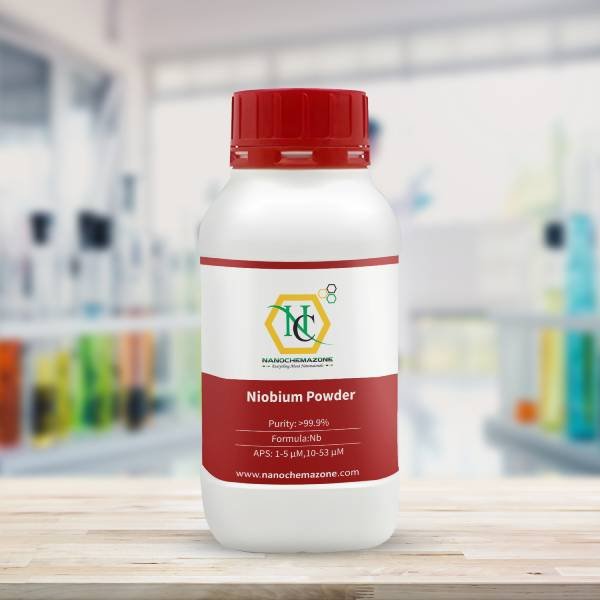


Niobium Powder
$0.00
Niobium Powder
| Product | Niobium Powder |
| CAS No. | 7440-03-1 |
| Appearance | Dark Gray Powder |
| Purity | ≥99%, ≥99.9%, ≥95%(Other purities are also available) |
| APS | 1-5 µM, 10-53 µM (Can be customized), Ask for other available size range. |
| Ingredient | Nb |
| Density | 8.57g/cm3 |
| Molecular Weight | 92.91g/mol |
| Product Codes | NCZ-DCY-332/25 |
Niobium Description:
Niobium Powder is one of the numerous advanced ceramic materials manufactured by Nanochemazone. Nanochemazone produces too many standard grades when applicable, including Mil Spec (military grade); ACS, Reagent and Technical Grade; Food, Agricultural and Pharmaceutical Grade; Optical Grade, USP and EP/BP (European Pharmacopoeia/British Pharmacopoeia) and follows applicable ASTM testing standards. Typical and custom packaging is available. Additional technical, research and safety (MSDS) information are available. Please request a quote above for more information on lead time and pricing.
Niobium Powder Related Information :
Storage Conditions:
Airtight sealed, avoid light and keep dry at room temperature.
Please contact us for customization and price inquiry
Email: contact@nanochemazone.com
Note: We supply different size ranges of Nano and micron as per the client’s requirements and also accept customization in various parameters.
Niobium Powder
Niobium is used in prosthetics and implant devices, such as pacemakers because it is physiologically inert and hypoallergenic. Besides, niobium powders are required as a raw material, in the fabrication of electrolytic capacitors.
Overview of Niobium Powder
Niobium is a shiny, white refractory transition metal with outstanding heat resistance and very high melting point. In powder form, it exhibits excellent thermal, electrical, and chemical stability.
Key properties of niobium powder include:
High heat resistance and refractory nature
Excellent corrosion resistance
Superconducting below 9.2K (-264°C)
Thermal and electrical stability
Low neutron absorption
High density powder with good chemical purity
Available in various particle size ranges
Niobium powder is used where its refractory, conductive, and superconductive properties can be utilized. The major applications include electronics, superconductors, alloys, chemical/heat resistant components, optical coatings, and pyrotechnics.
Composition of Niobium Powder
| Element | Purity |
| Niobium (Nb) | 99% min |
| Tantalum (Ta) | 0.5% max |
| Hafnium (Hf) | 0.01% max |
| Nitrogen (N) | 0.03% max |
| Carbon (C) | 0.05% max |
| Oxygen (O) | 0.1-0.2% |
| Hydrogen (H) | 0.0015% max |
High purity niobium powder contains over 99% niobium metal with low impurity levels. Commercial grades have higher permissible impurities.
Niobium powder exhibits the following properties:
| Property | Value |
| Density | 8.57 g/cm3 |
| Melting Point | 2477°C |
| Thermal Conductivity | 53 W/m∙K |
| Electrical Resistivity | 15 μΩ∙cm |
| Young’s Modulus | 105 GPa |
| Poisson’s Ratio | 0.40 |
| Tensile Strength | 550 MPa |
| Compressive Strength | 200 MPa |
| Vickers Hardness | 600 HV |
Production Methods for Niobium Powder
Niobium powder can be produced by methods like:
Hydriding-Dehydriding – Niobium ingots crushed into coarse powder and hydrided. The niobium hydride is vacuum dehydrided and milled into fine powder.
Calciothermic Reduction – Reduction of niobium oxide with calcium followed by consolidation and crushing to powder.
Electrolysis – Molten salt electrolysis of niobium oxide to produce niobium sponge which is crushed into powder.
Carbon Reduction – Niobium oxide is reduced with carbon and processed into powder.
The hydriding process is most common but carbon and electrothermal reduction offer higher purity powder.
Applications of Niobium Powder
Niobium powder is used in the following major applications:
Electronics – Capacitors, superconducting radio frequency cavities, Josephson junctions, integrated circuits.
Metal Alloys – Added to steels and nickel-based alloys for strength and heat resistance.
Coatings and Paints – Used in conductive coatings, spark-resistant paints, optical coatings.
Welding – As filler material for stainless steel, nickel alloys, and refractory metals.
Chemical Industry – Components like heat exchangers, reactors vessels utilizing niobium’s stability.
Pyrotechnics – As fuel and oxidizer in pyrotechnic formulations.
Specifications of Niobium Powder
Niobium powder is available under various specifications:
Purity Grades – From commercial purity to ultra high purity (99.99%) based on impurities.
Particle Sizes – Ranging from 1 micron to 150 microns for various applications.
Morphology – Irregular, spherical, nodular and flaked powder shapes.
Surface Area – From low surface area up to high surface area powder grades.
Oxygen Content – Low oxygen fine powder grades also available.
Custom Grades – Customer specific particle characteristics and purity.
Storage and Handling of Niobium Powder
Niobium powder requires controlled storage and handling to:
Prevent exposure to air and moisture to minimize oxidation
Avoid ignition and explosion hazards from fine powder
Use appropriate ventilation and respiratory protection during handling
Follow precautions in Safety Data Sheet from supplier
Store sealed containes in a cool, dry place away from incompatibles
Inert gas glove boxes, proper grounding and PPE should be used when handling niobium powder.
Inspection and Testing of Niobium Powder
The following inspections and tests are typically performed on niobium powder:
Chemical Analysis – Inductively coupled plasma or X-ray fluorescence techniques used for composition and purity check.
Particle Size Testing – Carried out as per ASTM B822 standard using laser diffraction technique.
Morphology – Scanning electron microscopy used for determining shape and surface area.
Specific Surface Area – BET gas absorption method used for measuring surface area per unit mass.
Impurities Testing – ICP-MS used to quantify levels of tantalum, oxygen, nitrogen and other impurities.
Powder Flow – Tested using Hall flowmeter as per ASTM B213 standard.
Comparison of Niobium and Tantalum Powder
Niobium and tantalum powders are two similar refractory metal powders compared:
| Parameter | Niobium Powder | Tantalum Powder |
| Density | 8.57 g/cm3 | 16.6 g/cm3 |
| Melting Point | 2477°C | 2996°C |
| Electrical resistivity | 15 μΩ.cm | 13 μΩ.cm |
| Tensile strength | 550 MPa | 400 MPa |
| Oxidation resistance | Moderate | Better |
| Cost | Lower | Higher |
| Applications | Alloys, capacitors | Medical, electronics |
Tantalum has higher density, melting point, and better oxidation resistance but is more expensive than niobium.
Niobium Powder FAQs
Q: How is niobium powder produced?
A: The main production methods for niobium powder are hydriding-dehydriding, calciothermic reduction, electrolysis, and carbon reduction of niobium oxide sources.
Q: What is niobium powder used for?
A: Major applications of niobium powder include electronics, metal alloys, coatings, chemical industry, welding, pyrotechnics, and superconductors.
Q: What is the typical niobium powder size for thermal spray coatings?
A: For thermal spray processes, niobium powder is typically used in particle size ranges of 45-150 microns. Finer powder can lead to oxidation issues.
Q: Is niobium powder flammable or explosive?
A: Yes, like other finely divided metals, niobium powder can potentially be flammable or explosive. Proper precautions are needed for safe handling and storage.
Q: Where can I buy high purity niobium powder for superconducting applications?
A: Ultra high purity (99.99%) niobium powder suitable for superconducting applications can be purchased from major supplier.
Description
Note: For pricing & ordering information, please get in touch with us at sales@nanochemazone.com
Please contact us for quotes on Larger Quantities and customization. E-mail: contact@nanochemazone.com
Customization:
If you are planning to order large quantities for your industrial and academic needs, please note that customization of parameters (such as size, length, purity, functionalities, etc.) is available upon request.
NOTE:
Images, pictures, colors, particle sizes, purity, packing, descriptions, and specifications for the real and actual goods may differ. These are only used on the website for the purposes of reference, advertising, and portrayal. Please contact us via email at sales@nanochemazone.com or by phone at (+1 780 612 4177) if you have any
Only logged in customers who have purchased this product may leave a review.
Related products
Molybdenum Powder
Molybdenum Powder
| Product | Molybdenum Powder |
| CAS No. | 7439-98-7 |
| Appearance | Dark Gray or Black Powder |
| Purity | ≥99%, ≥99.9%, ≥95%(Other purities are also available) |
| APS | 1-5 µM, 10-53 µM (Can be customized), Ask for other available size range. |
| Ingredient | Mo |
| Density | 10.2g/cm3 |
| Molecular Weight | 94.95g/mol |
| Product Codes | NCZ-DCY-331/25 |
Molybdenum Description:
Molybdenum Powder is one of the numerous advanced ceramic materials manufactured by Nanochemazone. Nanochemazone produces too many standard grades when applicable, including Mil Spec (military grade); ACS, Reagent and Technical Grade; Food, Agricultural and Pharmaceutical Grade; Optical Grade, USP and EP/BP (European Pharmacopoeia/British Pharmacopoeia) and follows applicable ASTM testing standards. Typical and custom packaging is available. Additional technical, research and safety (MSDS) information are available. Please request a quote above for more information on lead time and pricing.Molybdenum Powder Related Information :
Storage Conditions: Airtight sealed, avoid light and keep dry at room temperature. Please contact us for customization and price inquiry Email: contact@nanochemazone.com Note: We supply different size ranges of Nano and micron as per the client’s requirements and also accept customization in various parameters. Molybdenum Powder Molybdenum powder is a refractory metal powder made from molybdenum metal. It offers high temperature strength, corrosion resistance, thermal conductivity, and lubricity. Overview of Molybdenum Powder Molybdenum is a silvery-white refractory transition metal with very high melting point, excellent corrosion resistance, and good thermal/electrical conductivity. In powder form, it exhibits high strength at elevated temperatures along with stability in harsh environments. Key properties of molybdenum powder include: High temperature strength and creep resistance Excellent corrosion resistance Good thermal and electrical conductivity Low thermal expansion coefficient High hardness and wear resistance Good lubricity in sulfide atmospheres Available in various particle size distributions Molybdenum powder is used where its heat resistance, corrosion resistance, conductivity, and lubricity can be utilized. Major applications include alloying, electronics, coatings, welding, and specialty metals fabrication. Composition of Molybdenum Powder Molybdenum powder has the following typical composition:| Element | Purity |
| Molybdenum (Mo) | 99% min |
| Oxygen (O) | 0.01-0.5% |
| Carbon (C) | 0.01-0.1% |
| Iron (Fe) | 0.2-2% |
| Copper (Cu) | 0.1-0.5% |
| Silicon (Si) | 0.05-1% |
| Tungsten (W) | 0.1-1% |
| Sulfur (S) | 0.01-0.1% |
| Property | Value |
| Density | 10.22 g/cm3 |
| Melting Point | 2623°C |
| Thermal Conductivity | 138 W/m∙K |
| Electrical Resistivity | 5.5 μΩ∙cm |
| Young’s Modulus | 324 GPa |
| Poisson’s Ratio | 0.31 |
| Tensile Strength | 350 MPa |
| Yield Strength | 220 MPa |
| Elongation | 20% |
| Vickers Hardness | 200 HV |
| Parameter | Molybdenum | Tungsten |
| Density | 10.22 g/cm3 | 19.3 g/cm3 |
| Melting Point | 2623°C | 3422°C |
| Tensile Strength | 350 MPa | 350 MPa |
| Thermal Conductivity | 138 W/mK | 163 W/mK |
| Electrical Resistivity | 5.5 μΩ.cm | 5.5 μΩ.cm |
| Cost | Lower | Higher |
| Toxicity | Lower | Higher |

Tungsten Powder
Tungsten Powder
| Product | Tungsten Powder |
| CAS No. | 7440-33-7 |
| Appearance | Grey Powder |
| Purity | ≥99%, ≥99.9%, ≥95%(Other purities are also available) |
| APS | 1-5 µM, 10-53 µM (Can be customized), Ask for other available size range. |
| Ingredient | W |
| Density | 19.3g/cm3 |
| Molecular Weight | 183.85g/mol |
| Product Codes | NCZ-DCY-334/25 |
Tungsten Description:
Tungsten Powder is one of the numerous advanced ceramic materials manufactured by Nanochemazone. Nanochemazone produces too many standard grades when applicable, including Mil Spec (military grade); ACS, Reagent and Technical Grade; Food, Agricultural and Pharmaceutical Grade; Optical Grade, USP and EP/BP (European Pharmacopoeia/British Pharmacopoeia) and follows applicable ASTM testing standards. Typical and custom packaging is available. Additional technical, research and safety (MSDS) information are available. Please request a quote above for more information on lead time and pricing.Tungsten Powder Related Information :
Storage Conditions: Airtight sealed, avoid light and keep dry at room temperature. Please contact us for customization and price inquiry Email: contact@nanochemazone.com Note: We supply different size ranges of Nano and micron as per the client’s requirements and also accept customization in various parameters. Tungsten Powder Tungsten powders are used as consumables in industries such as 3D printing of tungsten and tungsten alloys, porous materials, and highly dense powder coating. With the rapid development of 3D printing technology, porous materials, highly dense powder coating, and injection molding, the demand for high-quality spherical tungsten powders is increasing. Tungsten powders are used as consumables in industries such as 3D printing of tungsten and tungsten alloys, porous materials, and highly dense powder coating. With the rapid development of 3D printing technology, porous materials, highly dense powder coating, and injection molding, the demand for high-quality spherical tungsten powders is increasing. High-quality spherical tungsten powder is not only good flowability, good sphericity, high apparent density and vibrational density, and low oxygen content. Product Properties Appearance: Grey powder Size: 15-40um Note: Other 3D printing powders are available upon any custom requirements| No | Name | Chemical Composition(wt%) |
| 1 | 18Ni300 | Ni17-19, Mo4.5-5.2, Co8.5-9.5, Ti0.6-0.8, Al0.05-0.15,Fe(Bal.) |
| 2 | Hastelloy Alloy | Fe17-20, Cr20.5-23, Mo8-10, W0.2-1, Co0.5-2.5, C0.05-0.15, Ni (Bal.) |
| 3 | AlSi10Mg | Si9-11,Mg0.2-0.45,Al(Bal.) |
| 4 | CoCrW | Cr26.5-29, W7-9, Si1.2-1.9, Co (Bal.) |
| 5 | Co28Cr6Mo | Cr27-29, Mo5-7, Co (Bal.) |
| 6 | Spherical Ti Powder | Ti≥99.9 |
| 7 | TC4 | Al5.5-6.8, V3.5-4.5, Ti (Bal.) |
| 8 | TA15 | Al5.5-7.1, V0.8-2.5, Mo0.8-2,Zr1.5-2.5, Al (Bal.) |
| 9 | 316L | Cr16.00-18.00, Ni10.00-14.00, Mo2.00-3.00, Fe (Bal.) |
| 10 | S136 | Cr12.0-14.0, Si0.8-1.0, V0.15-0.4, C0.2-0.45, Fe (Bal.) |
| 11 | In625 | Cr20-23Mo8-10, Nb 3.15-4.15, Co≤1, Fe≤1, Ni (bal.) |
| 12 | In718 | Cr17-21, Mo2.8-3.3, Nb 4.75-5.5, Co≤1, Ni50-51, Fe (Bal.) |
| 13 | Spherica WC | C3.7-4.2, W (Bal.) |
| 14 | Spherical Cr Powder | Cr≥99.9 |
| 15 | Spherica Mo Powder | Mo≥99.9 |
| 16 | Spherica Ta Powder | Ta≥99.9 |
| 17 | Spherica W Powder | W≥99.9 |
Reviews
There are no reviews yet.