
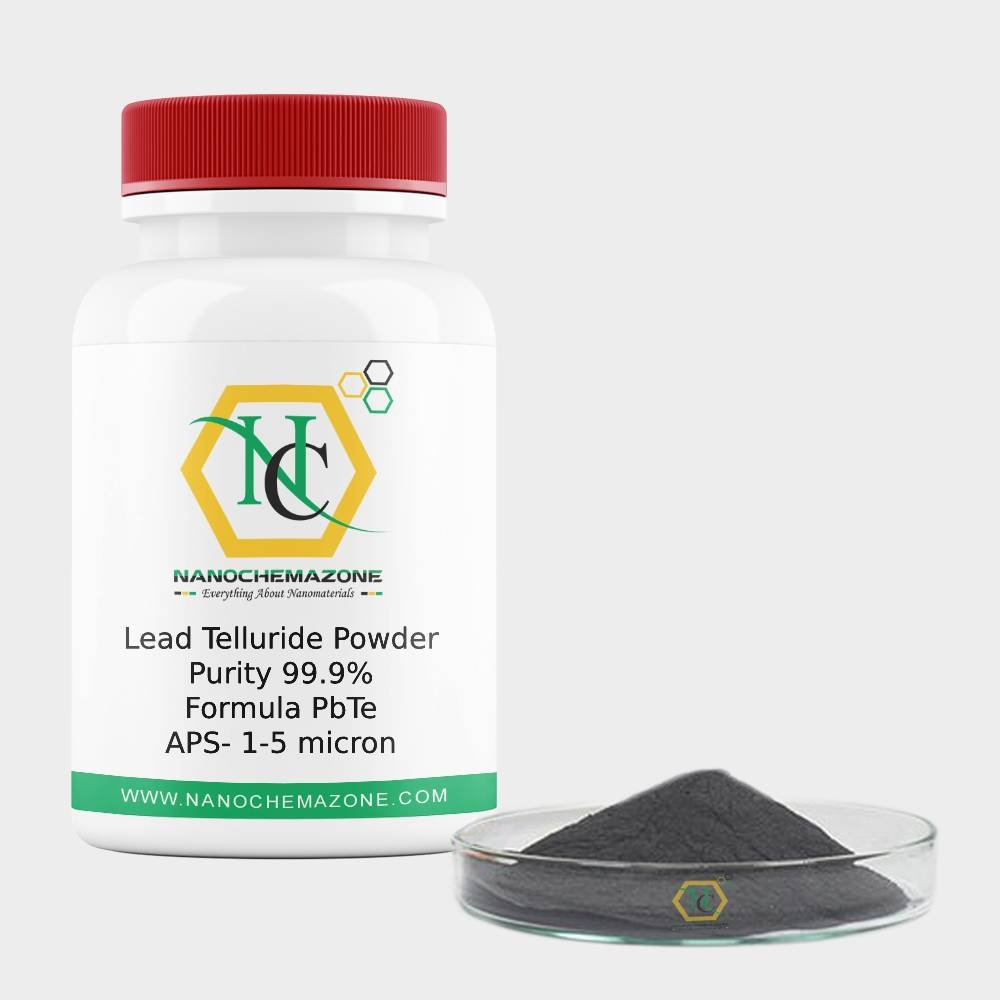

Lead Telluride Powder
$0.00
Product Name: Lead Telluride Powder
| Product | Lead Telluride Powder |
| CAS No. | 1314-91-6 |
| Appearance | Grey Powder |
| Purity | 99.9% |
| APS | 1 – 5 Microns (Can be customized) |
| Ingredient | PbTe |
| Product Code | NCZ-NSC-140/20 |
Lead Telluride Description :
Lead tin telluride is a ternary alloy of lead, tin, and tellurium, generally made by alloying either tin into lead telluride or lead into tin telluride. It is a narrow bandgap semiconductor material.
The bandgap is tuned by varying the composition(x) in the material. SnTe can be alloyed with Pb (or PbTe with Sn) to tune the bandgap from (SnTe). Lead Telluride Powder important to note that unlike chalcogenides, e.g. cadmium, mercury, and zinc chalcogenides, the bandgap in Te does not change linearly between the two extremes. In contrast, as the composition (x) is increased, the bandgap decreases approach zero in the concentration regime (0.32–0.65 corresponding to temperature 4-300 K, respectively) and further increases towards the bulk bandgap of SnTe. Therefore, the lead-tin telluride alloys have narrower band gaps than their endpoint counterparts making lead tin telluride an ideal candidate for mid-infrared, 3–14 μm optoelectronic application.
Lead Telluride Powder has a positive temperature coefficient i.e. for a given composition x, the bandgap increases with temperature. Therefore, temperature stability has to be maintained while working with lead-tin telluride based laser. However, the advantage is that the operating wavelength of the laser can simply be tuned by varying the operating temperature.
The optical absorption coefficient of lead-tin telluride is typical ~750 cm−1 as compared to ~50 cm−1 for the extrinsic semiconductors such as doped silicon. The higher optical coefficient value not only ensures higher sensitivity but also reduces the spacing required between individual detector elements to prevent optical cross-talk making integrated circuit technology easily.
Lead Telluride Related Information
Storage Conditions:
Airtight sealed, avoid light and keep dry at room temperature.
Please email us for the customization.
Email: contact@nanochemazone.com
Note: We supply different size ranges of nano and micron size powder as per the client’s requirements and also accept customization in various parameters.
Note: For pricing & ordering information, please contact us at sales@nanochemazone.com
Please contact us for quotes on Larger Quantities & Customization. E-mail: contact@nanochemazone.com
Customization:
If you are planning to order large quantities for your industrial and academic needs, please note that customization of parameters (such as size, length, purity, functionalities, etc.) are available upon request.
Other composition and customer’s specified configurations can be delivered upon request. Stabilizer, pH Value, Pack Size, and Contents of Artificial Lysosomal Fluid are customizable.
Contact us for Customization: sales@nanochemazone.com
Transportation and storage: Transportation at room temperature, storage at 4 ℃. For Longterm Storage Freeze it at -20 ℃


Only logged in customers who have purchased this product may leave a review.
Related products

Aluminum Diboride Powder
Aluminum Diboride Powder
Product Name: Aluminum Diboride Powder
| MF: | AlB2-P |
| Chemical Name | Aluminum Diboride |
| Color | Gray Black |
| EINECS | 234-923-7 |
| Purity: | 99.9% |
| Particle size | 30 µm (Customizable) |
| Product Number: | NCZ-SC-113/20 |
| Cas Number: | 12041-50-8 |
Aluminum Diboride Powder RELATED INFORMATION
Aluminum boride is an ionic compound, with a hexagonal crystal structure. Aluminum boride at an absolute temperature slightly 40K (equivalent to -233 ℃) will be transformed into a superconductor. And its actual operating temperature is 20 ~ 30K. To reach this temperature, we can use liquid neon, liquid hydrogen, or closed-cycle refrigerator to finish cooling. Compared to the current industry using liquid helium to cool the niobium alloy (4K), these methods are simpler and more economical. Once it is doped with carbon or other impurities, magnesium diboride in a magnetic field, or there is a current passing, the ability to maintain the superconducting is as much as niobium alloys, or even better.
Please email us for the customization. Email: contact@nanochemazone.com Please contact us for customization and price inquiry Note: We supply different size ranges of nano and micron size powder as per the client’s requirements and also accept customization in various parameters.
Aluminum Powder
Aluminum Powder
Product Name: Al Powder
| Product | Al Powder |
| CAS No. | 7429-90-5 |
| Appearance | Grey |
| Purity | 99.9% |
| APS | 1 – 5 Micron (Can be customized) |
| Ingredient | Al+3 |
| Product Code | NCZ-NSC-163/20 |
Description of Al (Aluminum Powder)
| 3D printing metal Powder Powder metallurgy, injection molding, spray painting, etc. |
Al Powder Related Information
Storage Conditions:
Airtight sealed, avoid light, and keep dry at room temperature. Please email us for the customization. Email: contact@nanochemazone.com
Bismuth Metal Polycrystalline Powder
Product Name: Bismuth Metal Polycrystalline Powder
| Product | polycrystalline |
| CAS No. | 7440-69-9 |
| Appearance | brown Powder |
| Purity | 99.9% |
| APS | 1 – 5 Microns (Can be customized) |
| Ingredient | Bi |
| Product Code | NCZ-NSC-275/20 |

Silicon Carbide Powder
Product Name: Silicon Carbide Powder
| Product | Silicon Carbide Powder |
| Colour | Black Powder |
| Purity | ≥ 99.9% |
| Particle size | 1-10 µM (customizable) |
| Ingredient/MF | SiC |
| Product Code | NCZ-C-104/20 |
| CAS Number | 409-21-2 |
Silicon Carbide Powder Description:
Silicon carbide is produced in the same way as Black silicon Carbide except for some differences in the raw material. Its crystallization has higher purity and hardness. Green silicon carbide is suitable for processing hard alloy, metallic and non-metallic materials with hard and brittle features such as copper, brass, Aluminum, magnesium, jewel, optical glass, ceramics, etc.
Silicon Carbide Applications:
- One of the best properties of silicon carbide is that it is resistant to alkali and acids.
- It retains strength when applied at high temperatures.
- It shows good electrical conductivity and shock resistance capacity and for this reason, it is preferred for applying in an electric furnace to heat elements.
- It is compatible to apply under extreme conditions of applications.
- Apart from that, this chemical component also shows considerable thermal expansion and conductivity.
- It is an ideal component for applications requiring good flexural strength.
- We provide this product after evaluating the properties, ingredients, and applicability to cover a wide range of industrial usages.
Advantages:
- Large melting furnace, longer melting time, lead to more crystallization, bigger crystals, higher purity, and fewer impurities.
- Beckman coulter particle size distribution instrument.
- The laboratory is registered at the government Import and Export Inspection Bureau.
Silicon Carbide Powder Related Information
Please email us for the customization. Email: contact@nanochemazone.com Please contact us for customization and price inquiry Note: We supply different size ranges of Nano and micron as per the client’s requirements and also accept customization in various parameters.
Single Crystal Silicon Wafer N-Type
Single Crystal Silicon Wafer N-Type (1 inch)
Product Name: Single Crystal Silicon Wafer N-Type (1 inch)
| Product Name | Single Crystal Silicon Wafer N-Type (1 inch) |
| Cat No. | NCZ-NSC330/20 |
| Size | 1 inch |
| Thickness | 300-380 micro-meter |
| Type | N-type |
| Dopant | Phosphorus |
| Resistivity | 1-10 ohm/cm |
| Surface | Single side polished |
| Boling Point | 2355 °C (lit.) |
| Melting Point | 1240 °C,1410 °C (lit.) |
| Density | 2.33 g/mL at 25 °C (lit.) |
| Semiconductor Properties | <100>, N-type |
| SMILES string | [Si] |
Single Crystal Silicon Wafer N-Type (1 inch). We have heated polished doped single-crystal silicon wafers in a single-mode microwave cavity to temperatures where surface to surface bonding occurred. The absorption of microwaves and heating of the wafers is attributed to the inclusion of n-type or p-type impurities into these substrates.
A cylindrical cavity TM (sub 010) standing wave mode was used to irradiate samples of various geometry at positions of high magnetic field. This process was conducted in a vacuum to exclude plasma effects.
This initial study suggests that the inclusion of impurities in single crystal silicon significantly improved its microwave absorption (loss factor) to a point where heating silicon wafers directly can be accomplished in minimal time. Bonding of these substrates, however, occurs only at points of intimate surface to surface contact. The inclusion of a thin metallic layer on the surfaces enhances the bonding process.
Please email us for the customization. Email: contact@nanochemazone.com Please contact us for customization and price inquiry Note: We supply different size ranges of Nano and micron as per the client’s requirements and also accept customization in the various parameters
Single crystal silicon wafer N-type (2 inch)
Single crystal silicon wafer N-type (2 inch)
Product Name: Single crystal silicon wafer N-type (2 inch)
| Product Name | Single crystal silicon wafer N-type (2 inch) |
| Cat No. | NCZ-NSC332/20 |
| Diameter | 2 inch |
| Doping | N type |
| Resistivity | (1-10 Ohm/sq). |
| Thickness | 290 + 10 µm |
| Orientation | 100 |
| Polished | Single side polished |
| Form | crystalline (cubic (a = 5.4037) |
| Polished | wafer (single side polished |
| does not contain | dopant |
| dia | 2 inch |
| Thickness | 0.5 mm |
| Boling Point | 2355 °C (lit.) |
| Melting Point | 1410 °C (lit.) |
| Density | 2.33 g/mL at 25 °C (lit.) |
| Semiconductor properties | <100>, N-type |
| SMILES string | [Si] |
Single crystal silicon wafer N-type (2 inch) Nanochemazone® Supplies provides both standard and customized high-quality single crystals, wafers and substrates for a wide range of applications such as LED, ferroelectric, piezoelectric, electro-optical, photonics, high power electronics, and high-frequency power devices, just to name a few. Customized crystal growth, precision machining, and coating services are available. Please contact us today to discuss your project requirements.
Please email us for the customization. Email: contact@nanochemazone.com Please contact us for customization and price inquiry Note: We supply different size ranges of Nano and micron as per the client’s requirements and also accept customization in the various parameters.
Tantalum carbide Powder
Product Name: Tantalum Carbide Powder
| Product | Tantalum Carbide Powder |
| Colour | Brown-Gray |
| Purity | ≥ 99.9% |
| Particle size | 1-10 µM (customizable) |
| Ingredient/MF | TaC |
| Product Code | NCZ-C-105/20 |
| CAS Number | 12070-06-3 |
Tantalum carbide Powder Description:
Tantalum carbides form a family of binary chemical compounds of tantalum and carbon with the empirical formula TaCx, where usually varies between 0.4 and 1. They are extremely hard, brittle, refractory ceramic materials with metallic electrical conductivity. They appear as brown-Gray powders, which are usually processed by sintering. Being important cermet materials, tantalum carbides are commercially used in tool bits for cutting applications and are sometimes added to tungsten carbide alloys.Properties of TaC Tantalum carbide powder:
Tantalum carbides have metallic electrical conductivity, both in terms of its magnitude and temperature dependence. TaC is a superconductor with a relatively high transition temperature of TC = 10.35 K. Application of TaC Tantalum carbide powder- Widely used in the production of microwave absorbing materials, metal powder injection
- Used as all kinds of superhard material and powder metallurgy products additives etc.
- Used as a cutting tool.
- Used for delicate Ceramics.
- Hard wear-resistant alloy tools, tools, molds, and wear-resistant corrosion-resistant structural components additive, improve the toughness of the alloy.
- Tantalum carbide sintered shown in gold, watches can be made decorations.

Zirconium Carbide Powder
Zirconium Carbide Powder
Product Name: Zirconium Carbide Powder
| Product | Zirconium Carbide Powder |
| Colour | Black |
| Purity | ≥ 99.9% |
| Particle size | 1-10 µM (customizable) |
| Ingredient/MF | ZrC |
| Product Code | NCZ-C-110/20 |
| CAS Number | 12070-14-3 |
Reviews
There are no reviews yet.